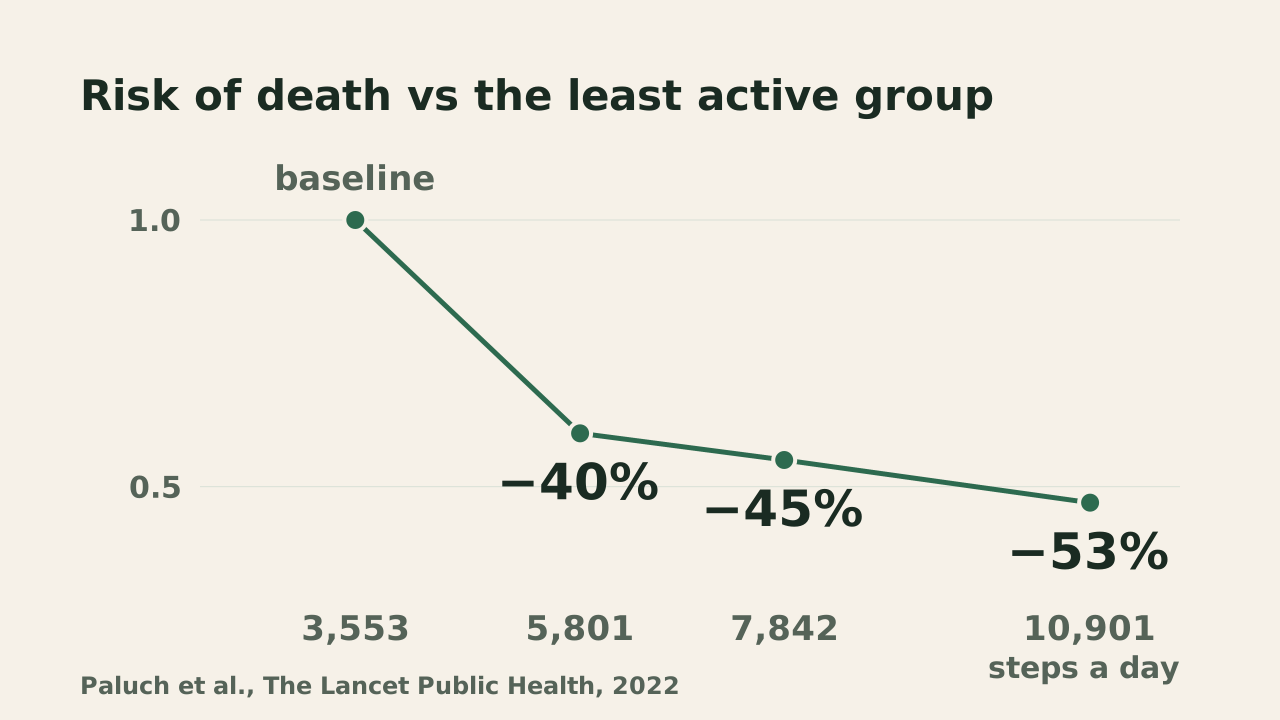
In short: in a large meta-analysis of 15 cohorts, people who walked more were less likely to die during follow-up1. For adults 60 and older, risk kept falling up to about 6,000–8,000 steps a day and then leveled off. For adults under 60, it kept falling up to about 8,000–10,000. The biggest gap was between the least active group and the next one up. This is an observational study, not an experiment, so it cannot prove that the steps themselves extend life.
What the study was
The Steps for Health Collaborative published the analysis in The Lancet Public Health in 20221. The authors pooled 15 cohorts, 7 published and 8 unpublished, and each team processed its own participants’ data with the same protocol.
- 47,471 adults;
- steps were counted by devices, pedometers or accelerometers mostly worn at the hip, not by questionnaires;
- median follow-up of 7.1 years;
- 3,013 deaths over that time, taken from death certificates and national registries.
The work was funded by the US Centers for Disease Control and Prevention (CDC).
What it found
Participants were split into four groups by daily steps, and each group was compared with the least active one:
| Group | Median steps a day | Risk of death vs group 1 |
|---|---|---|
| 1 | 3,553 | reference |
| 2 | 5,801 | 40% lower |
| 3 | 7,842 | 45% lower |
| 4 | 10,901 | 53% lower |
We converted the paper’s hazard ratios of 0.60, 0.55, and 0.47 into percentages1. These are relative differences during follow-up, not “40% more life.”
The curve flattened at different points by age. In adults 60 and older, risk fell up to about 6,000–8,000 steps a day; in adults under 60, up to about 8,000–10,0001. Above those numbers there was no clear extra difference.
What about walking pace?
The authors also looked at cadence, or steps per minute. Once total steps were taken into account, the link with pace weakened. The fastest 30 minutes of the day stayed linked with lower risk, but time spent walking at 100 or more steps per minute did not1. Put simply, in this study the total amount of walking mattered more than speed.
What this study does not prove
- A link, not a cause. People who walk a lot are often healthier to begin with. Someone who is ill walks less, which shows up in the data as “few steps, higher risk.” The authors adjusted for many factors and still note that reverse causation and unmeasured factors may remain1.
- One measurement. Steps were measured once, usually over a week, and changes after that were not tracked1.
- Not extra years. A hazard ratio tells you how much less often people died over about 7 years, not how many more years they lived.
- Not a magic number. 10,000 steps was not a threshold in this analysis. For older adults the benefit leveled off sooner.
What to take from it
If you currently walk about 3,000–4,000 steps a day, the biggest difference in these data is between the first and second groups: from about 3,500 to about 6,000 steps. There is no need to chase 10,000 right away. Adding 1,000–2,000 to your current average is easier and more realistic. The WHO sets its advice in minutes rather than steps: at least 150 minutes of moderate activity a week2. Brisk walking counts.
How to fit steps into an ordinary day, and how many calories they use, is covered in walking and weight loss. If getting outside is hard, exercise snacks can help.
Common questions
So is 10,000 steps a myth?
More of a simplification. In this meta-analysis the benefit kept growing up to about 8,000–10,000 steps for adults under 60 and up to 6,000–8,000 for those 60 and older1. For many people a reasonable goal is below 10,000, which is good news.
Do steps around the house count?
Yes. The devices in these cohorts counted every step while they were worn, not just walks. The authors note that very slow steps may be missed, and that a watch on the wrist counts differently from a pedometer at the hip1.
Sources
- Paluch A.E. et al. Daily steps and all-cause mortality: a meta-analysis of 15 international cohorts. The Lancet Public Health, 2022;7(3):e219–e228.
- WHO fact sheet: physical activity. Recommendations for adults.
What readers think
Lean Wisely articles are general reading. See the disclaimer.