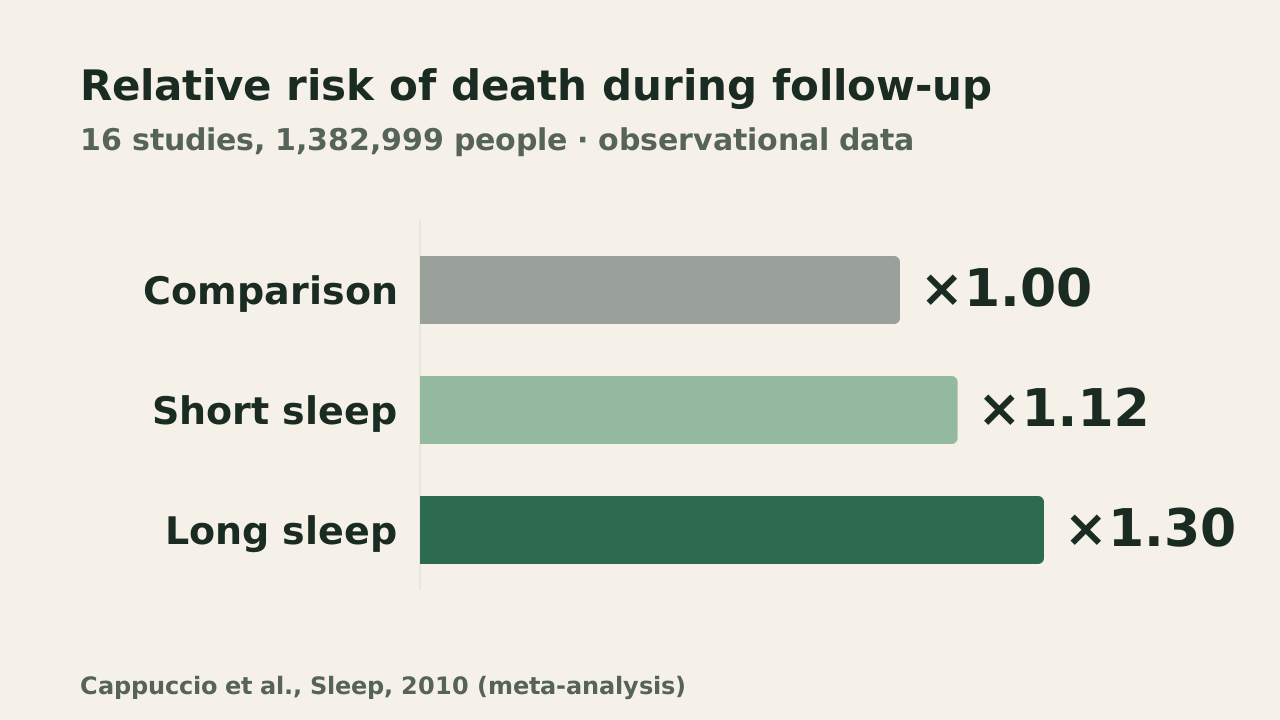
In short: a meta-analysis of 16 prospective studies found that people who reported short sleep had a 12% higher relative risk of dying during follow-up, and people who reported long sleep a 30% higher one1. Sleep was self-reported on questionnaires, and these studies observe people rather than assign them a bedtime. It shows a link, not that changing your sleep changes your lifespan.
What kind of study this is
The paper is a systematic review and meta-analysis by a team at the University of Warwick, published in the journal Sleep in 20101. The authors searched several databases (MEDLINE, EMBASE and the Cochrane Library) and kept only prospective studies: people were asked about sleep first and followed afterwards, for more than 3 years.
- 16 studies, which gave 27 independent cohort samples;
- 1,382,999 men and women, followed for 4 to 25 years;
- 112,566 deaths, so about 8% of all participants died during follow-up (our division of the two totals);
- sleep duration came from questionnaires and deaths from death certificates1.
The abstract does not report who funded the work, so we cannot tell you.
What the pooled numbers say
| Reported sleep | Relative risk of death | 95% interval |
|---|---|---|
| Short | 1.12 | 1.06–1.18 |
| Long | 1.30 | 1.22–1.38 |
A relative risk of 1.12 means the rate of death was 12% higher than in the comparison group, not that 12 in 100 people died because of short sleep1. The abstract does not give absolute risks for each group, so we cannot turn these into “extra deaths per 1,000 people”. It also does not state the hour cut-offs for “short” and “long”, so check the paper itself before quoting a number of hours.
What this study does not show
- That sleep is the cause. These are observational studies. People who sleep very little or very long may differ in health, work, stress and habits, and the abstract does not separate those effects.
- That the link runs from sleep to death. Illness can change how long someone sleeps, so a link in the other direction is possible too. The abstract does not test it.
- A uniform result. The studies disagreed with each other: heterogeneity was present for short sleep (P = 0.02) and stronger for long sleep (P < 0.0001)1. The long-sleep figure is the less consistent one.
- Accurate hours. People estimated their own sleep on questionnaires, and people tend to be approximate about it.
- Recent evidence. The searches ended in 2009. Newer studies, including those using sleep trackers, are not part of this analysis.
What to take from it
The US National Heart, Lung, and Blood Institute says experts recommend 7 to 9 hours a night for adults, and that adults who sleep less than 7 hours may have more health issues than those who sleep 7 or more2. The same page says that sleeping more than 9 hours is not necessarily harmful and may be helpful for young adults, people recovering from sleep deprivation, and people who are sick2.
So the reasonable reading is modest: regularly sleeping much less than most adults need is worth fixing if you can, and there is no case for staying in bed longer to “buy” years. If you are always tired, or you suddenly need much more sleep than before, that is a question for a doctor, not a number on a tracker.
For the weight side of the story, see sleep and weight. For other large studies on daily habits, see how many steps a day are linked to a longer life and cardio fitness and longevity.
FAQ
Is 6 hours of sleep dangerous?
This meta-analysis cannot say, because the abstract does not give hour cut-offs. The NHLBI advice is 7 to 9 hours for adults, with the note that fewer than 7 may go with more health problems2. That is a general guideline, not a diagnosis for you.
Does sleeping more than 9 hours shorten life?
The study found a link between long sleep and higher risk of death1, but it cannot show that long sleep itself is harmful. The NHLBI says more than 9 hours is not necessarily harmful2. If your need for sleep has changed a lot, mention it to a doctor.
Can I make up for lost sleep with a long weekend lie-in?
This analysis did not look at that, so it has no answer.
Sources
- Cappuccio F.P. et al. Sleep duration and all-cause mortality: a systematic review and meta-analysis of prospective studies. Sleep, 2010;33(5):585–592.
- NHLBI (US National Institutes of Health): How much sleep is enough?
What readers think
Lean Wisely articles are general reading. See the disclaimer.