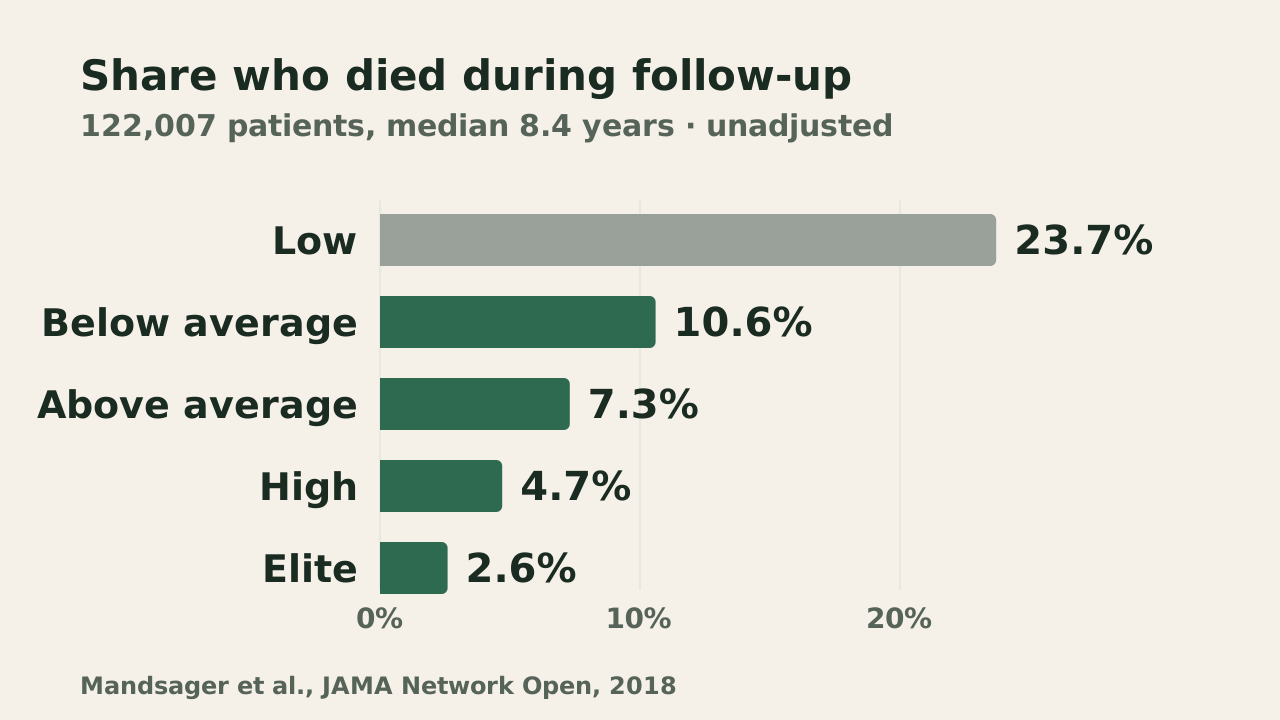
In short: in a large Cleveland Clinic study, the higher a patient’s aerobic fitness on a treadmill test, the less often they died during follow-up1. Among the least fit, almost one in four died (23.7%); among the fittest, 2.6%. This is an observational look at people who were sent for a test, not an experiment. It shows a link, not that fitness itself extends life.
What the study was
A Cleveland Clinic team published it in JAMA Network Open in 20181. It is a retrospective cohort study: the authors took existing records and looked at what happened to people afterward.
- 122,007 adults, mean age 53.4, 59.2% men;
- all had a treadmill test at one clinic between 1991 and 2014, usually because of symptoms or a suspected heart problem;
- fitness was estimated from peak workload in METs (metabolic equivalents), then compared with people of the same age and sex;
- median follow-up was 8.4 years, and 13,637 people (11.2%) died in that time.
The authors reported no conflicts of interest1.
Five fitness groups
Patients were sorted by percentile within their own age and sex group: low (below the 25th), below average, above average, high, and “elite” (97.7th percentile and up)1.
| Group | Peak level, METs (mean) | Died during follow-up |
|---|---|---|
| Low | 6.1 | 23.7% |
| Below average | 8.2 | 10.6% |
| Above average | 9.6 | 7.3% |
| High | 11.4 | 4.7% |
| “Elite” | 13.8 | 2.6% |
These percentages from the paper’s table are crude: no adjustment for age, smoking, diabetes, and so on. The groups also differed in health. Coronary artery disease was present in 22.2% of the low-fitness group and 9.9% of the elite group; diabetes in 21.9% and 2.4%1. That is why the authors compared groups with an adjusted model.
What the adjusted model found
- ”Elite” vs low: hazard ratio 0.20 (95% CI 0.16–0.24). The reverse, low vs elite, is 5.041.
- Below average vs above average: 1.41. For comparison, smoking was 1.41, diabetes 1.40, and coronary artery disease 1.291.
- Even “elite” vs high: 0.77 (0.63–0.95). In people 70 and older: 0.71 (0.52–0.98)1.
The authors conclude that they saw no upper limit of benefit1. A hazard ratio describes how fast deaths accumulated over about 8 years. It is not “5 extra years of life”.
What this study does not show
- Cause. The authors say so directly: a retrospective design cannot separate “fitness lowers mortality” from “healthier people reach high fitness more easily”1.
- Everyone. The sample is people whose doctors sent them for a test, not random adults. They were probably more likely to have heart problems1.
- Unmeasured factors. The authors name socioeconomic status, race and ethnicity, plus genes and habits that could affect both fitness and survival1.
- What to train. The test measures the result, not which workout gets you there. It is not a study of training programs.
What to take from it
Fitness usually rises with ordinary, regular activity. The WHO recommends at least 150 minutes of moderate activity a week for adults2. Brisk walking counts. How many steps that usually means is in how many steps a day are linked to a longer life, and how to mix easy and livelier sessions is in zone 2 vs HIIT. Add load gradually. If you have heart disease, diabetes, or chest pain on exertion, talk to a doctor first. You can estimate your current average with the steps calculator.
FAQ
Do I have to train up to “elite”?
No. “Elite” here is the top 2.3% for age and sex, and the data on them are the least certain (there were 3,570 people)1. The biggest jump is between the lower groups, so a sensible first step is leaving the bottom category.
Can fitness improve after 60?
This study did not test training, so it has no answer. It only showed that among people 70 and older, the gap between “elite” and high fitness was also visible1.
Sources
- Mandsager K. et al. Association of cardiorespiratory fitness with long-term mortality among adults undergoing exercise treadmill testing. JAMA Network Open, 2018;1(6):e183605.
- WHO: physical activity fact sheet.
What readers think
Lean Wisely articles are general reading. See the disclaimer.