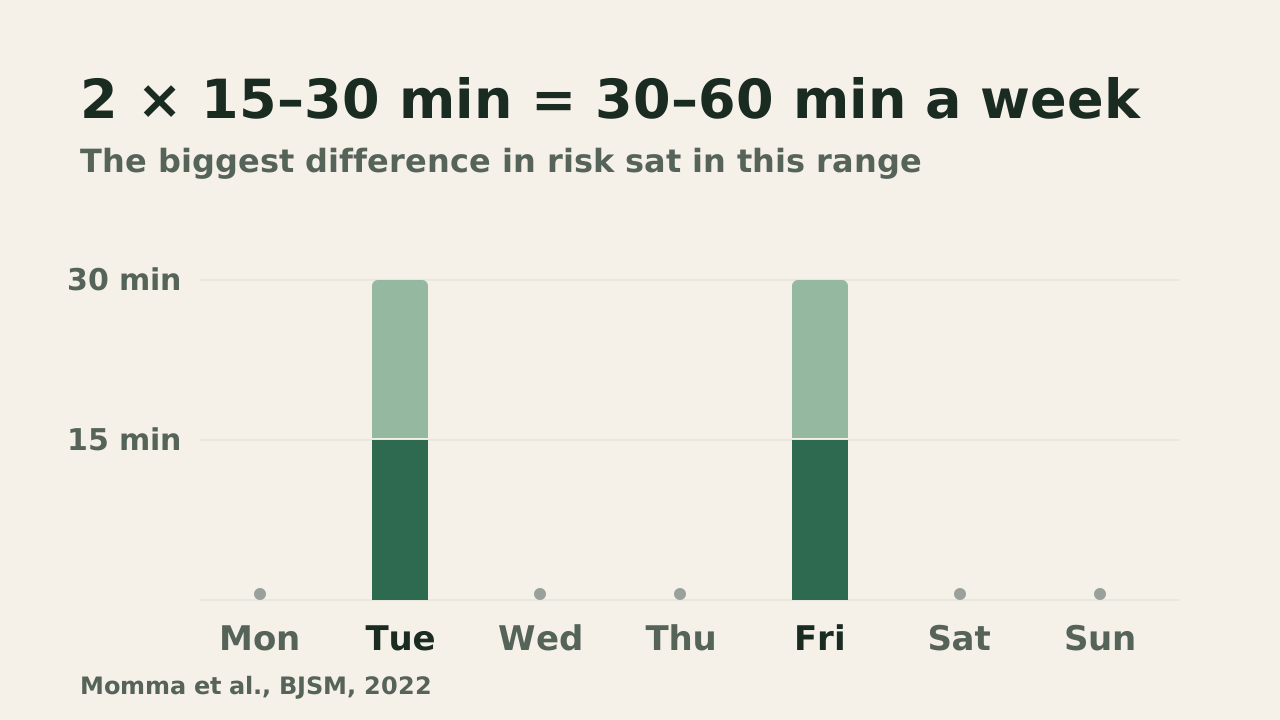
In short: in a meta-analysis of 16 cohort studies, people who did muscle-strengthening exercise were less likely to die from any cause and less likely to develop cardiovascular disease, cancer, and diabetes1. The biggest difference, around 10–20%, came at about 30–60 minutes of strength work a week. Beyond that the curve turned back up, so “the more, the better” does not follow from these data. These are observational studies, not an experiment.
What the study was
Momma and colleagues pooled prospective cohort studies published up to June 2021 and reported the meta-analysis in the British Journal of Sports Medicine in 20221.
- 16 studies met the criteria.
- Participants were adults without severe health conditions at the start.
- The link with strength work was estimated separately from aerobic activity such as walking, running, or cycling.
- Strength work means any exercise that loads the muscles: bodyweight, bands, dumbbells, or gym machines.
What it found
- Muscle-strengthening activity was linked with a 10–17% lower risk of death from any cause, cardiovascular disease, total cancer, diabetes, and lung cancer1.
- For all-cause death, heart disease, and total cancer, the curve was J-shaped: the largest reduction, roughly 10–20%, came at about 30–60 minutes a week1.
- For diabetes the curve was L-shaped, with a large drop in risk up to 60 minutes a week1.
- Strength work combined with aerobic activity was linked with lower risk of death from any cause, heart disease, and cancer than doing neither1.
- No link was found for some specific cancers (colon, kidney, bladder, and pancreatic)1.
Why more is not always better
A J-shaped curve means that past 30–60 minutes a week the benefit in these data stopped growing, and at high volumes the link even weakened. The authors themselves say the effect of a higher volume is unclear1. That is not proof of harm. But it is no reason to train every day for the sake of longevity either.
What this study does not prove
- A link, not a cause. People who lift may differ in diet, smoking, income, and starting health. Cohort studies try to adjust for this but cannot do it completely.
- Not a specific program. Volume was counted in minutes a week, without detail on exercises or loads.
How to start without a gym
The WHO recommends regular muscle-strengthening activity for all age groups2, and the NIDDK spells it out for adults: at least 2 days a week, such as lifting weights or doing push-ups3. Two sessions of 15–30 minutes add up to the 30–60 minutes a week where the meta-analysis saw the biggest difference.
- Sit-to-stand squats from a chair, wall or counter push-ups, glute bridges, band rows.
- For example, 1–3 sets of 8–15 reps, so the last few take real effort.
- A 20-minute example is in home workouts for beginners, and if time is very short, try exercise snacks.
If you are losing weight, strength work helps keep muscle, which matters even more on a GLP-1 medicine: strength training on GLP-1. With heart or joint problems, or after surgery, agree on a plan with your doctor.
Common questions
Does walking count as strength training?
No, walking is aerobic activity. The meta-analysis counted strength work separately, and the best result came from combining both1. On steps and longevity, see how many steps a day are linked to a longer life.
Can I start after 60?
Yes. The WHO recommends strength work for every age group2. Start with light loads and exercises where you can hold on to something.
Sources
- Momma H. et al. Muscle-strengthening activities are associated with lower risk and mortality in major non-communicable diseases: a systematic review and meta-analysis of cohort studies. British Journal of Sports Medicine, 2022;56(13):755–763.
- Bull F.C. et al. World Health Organization 2020 guidelines on physical activity and sedentary behaviour. British Journal of Sports Medicine, 2020;54(24):1451–1462.
- NIDDK, page on dieting and gallstones: adults also need muscle-strengthening activity at least 2 days a week.
What readers think
Lean Wisely articles are general reading. See the disclaimer.