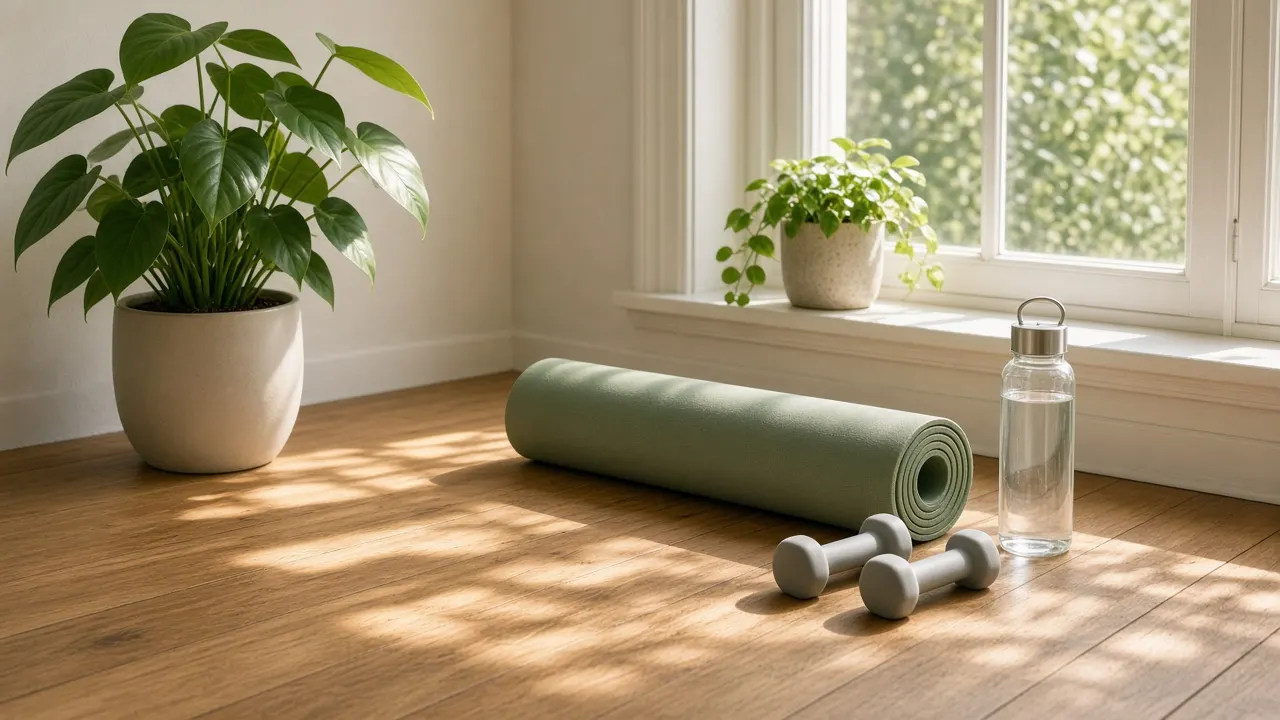
You do not need a gym membership to move more. Home workouts work for beginners when they are short, regular, and not a pain marathon.
Movement helps you use energy, keep muscle, and lift mood. At home a simple set is enough: sit-to-stand squats to a chair, wall or table push-ups, hip hinges / glute bridges, a kneeling plank, easy stretching. You do not need a perfect one-hour programme from the internet. You need 15–25 minutes two or three times a week (ACSM describes 2–3 days a week for novice strength work), plus walking on ordinary days. CDC asks adults for at least 150 minutes of moderate activity a week, such as brisk walking, and muscle-strengthening for the major muscle groups on at least 2 days. WHO likewise describes at least 150 minutes of moderate activity a week.
Safety first
- Sharp joint pain — stop. Effort discomfort is not the same as injury, but a crack-and-shoot sensation is a reason to stop.
- Start with a small number of reps; add a week later.
- Breathe evenly. Do not hold your breath on the effort.
- Heart, joint, or pregnancy concerns — agree the load with a clinician.
A session does not “burn off pizza in 20 minutes”. It supports shape and the habit of moving. The main contribution to weight is still average eating — see calorie deficit.
How to fit it into a real week
Tie the session to something you already do: after morning tea, before a shower, while dinner comes to a boil. Leave the mat where you can see it. Missed a day? Not the end. Come back on the next planned day. These pages are general; see the disclaimer.
A starter week
Monday and Thursday: 8–10 chair squats, 6–8 wall push-ups, 8 glute bridges, 15–20 seconds kneeling plank — two rounds with rest. Other days, ordinary walking. After two weeks add two reps or a third round. Moderate muscle ache is normal; joint pain means you should shrink the range. Tick the session as done: the brain likes a streak of “I did it” more than a perfect app programme.
Kit is optional
A water bottle instead of a dumbbell, a backpack with books, a band — all optional. First, the habit of moving for 15 minutes. When that becomes boring in a good way, you can make it harder. Comparing yourself to “30-day transformation” clips usually only demotivates beginners.
If those 15 minutes already feel easy and you want a little more resistance without a gym, a set of loop bands is one way to add it. One ordinary set is the Fit Simplify resistance loop bands on Amazon. If you buy through that link, we may earn a commission. Bands stay optional. They do not replace the 15-minute habit. When you want a load you can raise in small steps, that choice is adjustable dumbbells for beginners. If your knees are the reason you skip the floor work, the surface question is whether you need a mat.
In short
At home, 15–25 minutes two or three times a week, plus an ordinary walk, is enough. If it fits the evening, it is already working.
Pair this with walking and habits instead of motivation.
Walking and weight · Habits · Reading list
Common questions
How should a beginner start at home?
15–25 minutes two or three times a week: chair squats, wall push-ups, glute bridges, a kneeling plank — plus walking on ordinary days.
Do you need a gym to get more active?
No. Regularity, technique without sharp joint pain, and a habit you can repeat matter more than the building.
Sources
- CDC: at least 150 minutes of moderate activity a week, and muscle-strengthening on 2 or more days.
- ACSM position stand, Medicine & Science in Sports & Exercise, 2009: novice resistance training, 2–3 days a week.
- WHO fact sheet: at least 150 minutes of moderate-intensity activity a week.
What readers think
Lean Wisely articles are general reading. See the disclaimer.