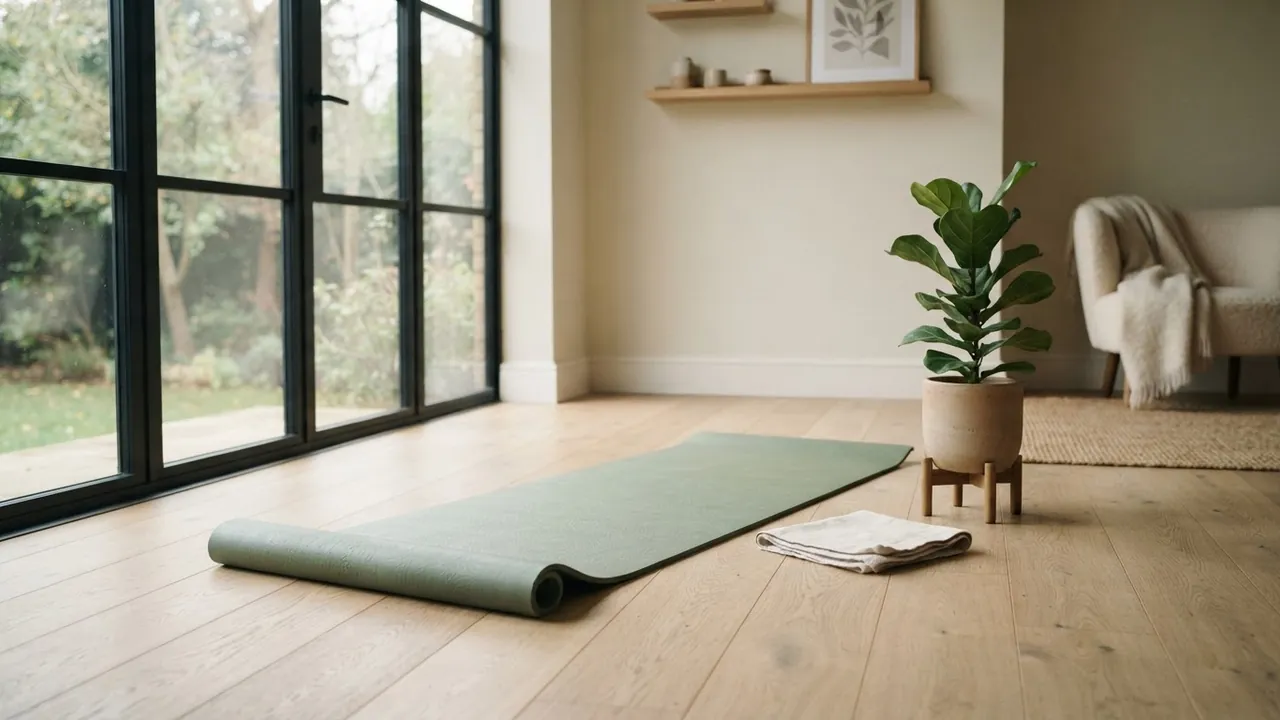
On a hard floor, a mat is worth it for your knees and wrists during floor work such as a glute bridge or a kneeling plank. For sore knees, go thick: about 1/2 inch of dense foam. On carpet the floor is already soft, so choose a firmer mat with a grippy underside rather than more foam. It does not make the session use more energy, and it does not replace the session. The beginner version of that session is home workouts for beginners.
Thickness is the actual choice. About 1/2 inch (about 13 mm) cushions knees on wood or tile. A thinner mat, about 6 mm (1/4 inch), is steadier if you also stand and balance, and it is less kind to knees. A mat that is both very thick and very soft can feel like kneeling on a cushion that collapses, which is uncomfortable in a different way.
What the mat is doing
The moves in a basic home session put body weight on a small area: kneecaps, wrists, the back of the hips. Carpet spreads that a little. Bare floor does not. A mat is a layer between you and the floor. It is not a piece of equipment that trains a muscle by itself.
CDC’s muscle-strengthening guideline is still two days a week for the major muscle groups. You can meet it on a towel. The mat only decides whether you will do the floor version again tomorrow because your knees did not hurt from the surface. Pain inside a joint is a different problem from a hard floor. Stop for sharp joint pain, and do not buy a thicker mat to push through it. (Adult activity, and the disclaimer.)
If the session is mostly standing — a walk, a chair squat — you may not need a mat at all. Walking does not need one: walking and weight.
A thick mat for bad knees
Kneeling on a hard floor presses a small area of the kneecap into the ground. Dense foam about 10 to 15 mm thick (roughly 1/2 inch) spreads that pressure; Home mats that thick are often NBR foam. The Amazon Basics mat below is 1/2 inch of NBR. Two more tricks cost nothing: fold the end of the mat double under your knees for kneeling moves, or swap a kneeling plank for a plank with your forearms on a sofa seat.
Go no thicker than you need. A mat much past 1/2 inch, or one that is very soft, gives way when you stand or step on it, and that makes balance harder. A mat cushions pressure from the floor. It does not treat a painful joint. Knee pain that stays after the session, swelling, or a knee that gives way is a reason to see a clinician, not to buy more foam.
An exercise mat for carpet
Carpet already gives you some cushion, which is why a towel works for the first weeks. Adding a thick, soft mat on top stacks two soft layers, which feels unsteady when you stand, lunge, or step. On carpet, a firm mat around 6 mm with a textured or rubbery underside is the better buy. A large mat helps if your session includes stepping or side-to-side moves, because a 24-inch-wide mat is easy to step off. The Gorilla Mats pick below is that kind of mat.
How to choose
- Measure your height against the mat. A common length is 68 to 74 inches. If you are tall, your feet hang off a short mat in a long stretch. That is annoying, not dangerous.
- Width around 24 inches is the usual home mat. Wider is nicer if your elbows fall off during a bridge.
- Thickness: 1/2 inch when knees are on a hard floor; closer to 6 mm when you want to feel the floor under your feet.
- A strap is useful if you will roll it and lean it in a closet. A mat left in the way gets used. A mat stored flat under a bed often does not.
- Wipe it. Open-cell foam holds sweat. Let a new PVC mat air out if it smells; that smell is the material, not proof that the workout “works.”
You do not need alignment lines, a yoga video, or a second mat for “recovery.”
Three mats
As an Amazon Associate, Lean Wisely earns from qualifying purchases. Sizes and materials below are what the listings state, not a mat we knelt on. A folded bath towel is the no-buy option and is the right one for the first two weeks if you are only finding out whether you will do the session.
The Amazon Basics 1/2-inch exercise mat (ASIN B01LP0UX9G, the pink one) is listed at about 74 by 24 by 0.5 inches, in NBR foam, with a strap. The half-inch thickness is the reason to pick it for glute bridges and kneeling planks on a hard floor. The length is a bit more than a standard 72-inch mat, which helps taller people. It is a poor choice if you mostly stand and balance: a soft half-inch surface moves under your feet. The listing says to wipe it rather than machine-wash it. NBR can hold odor if it stays rolled up damp. This ASIN is the pink mat. The black and blue versions are separate listings and showed only one left in stock when we checked on 30 September 2026.
The Gaiam Essentials 6 mm yoga mat (ASIN B07H9KV2YL) is the green mat listed at 72 by 24 inches and 1/4 inch (6 mm), in PVC, with a carrying sling, and a listed weight around 3.5 pounds. The page calls it 6P-free, meaning the maker says it is made without six named phthalates. That is their materials claim, not a test we ran. Choose this one if you want a firmer surface and you will stand on it as well as kneel. It is less cushion for sore knees on tile. Air it out before the first use if the PVC smell is strong. A 72-inch length is short if you are much over about 6 feet and you lie down lengthwise. Other colors are other ASINs.
The Gorilla Mats large exercise mat, 6 × 4 ft (ASIN B06XXPQZBP) is the carpet option. The listing gives a 6 by 4 foot mat, 1/4 inch (6 mm) thick, about 14 pounds, with a patterned bottom meant to stop it sliding, and says it works on carpet, hardwood, concrete and tile, with or without shoes. A towel, a carry bag and two straps are included. Choose it if you work out on carpet, or if your session has stepping or side-to-side moves that keep taking you off a narrow mat. Skip it if sore knees are the main issue: 6 mm is firm, so fold it or add a kneeling pad. At 14 pounds and 4 feet wide it is bulkier to roll and store than a yoga mat, and it costs much more than the other two; larger sizes are separate options on the same page.
If you later add dumbbells, the mat is still just the floor. The weight decision is separate: adjustable dumbbells for beginners.
In short
Hard floor and floor exercises: a thicker mat, about 1/2 inch, so your knees are willing to come back. Standing work: a thinner, firmer mat. Carpet: a towel to start, then a firm mat with a grippy back if you want one. The session is the two short days. The mat is optional padding.
Common questions
Is a yoga mat the same as an exercise mat?
In a shop, the names overlap. For this site’s home session, you need a surface that cushions knees on a hard floor. A thin “travel” yoga mat is a poor match for that. A very thick, squishy mat is a poor match for standing balance. Pick from the job, not from the word on the package.
Can I work out without one?
Yes. Carpet, a rug, or a towel covers the first weeks. Buy a mat when the floor is the reason you skip the kneeling parts, not before you have done the session at all.
Sources
- CDC, Adult activity: muscle-strengthening activity on at least 2 days a week for the major muscle groups, plus 150 minutes of moderate activity.
- US Department of Health and Human Services, Physical Activity Guidelines for Americans, 2nd edition, 2018: muscle-strengthening on 2 or more days a week.
What readers think
Lean Wisely articles are general reading. See the disclaimer.