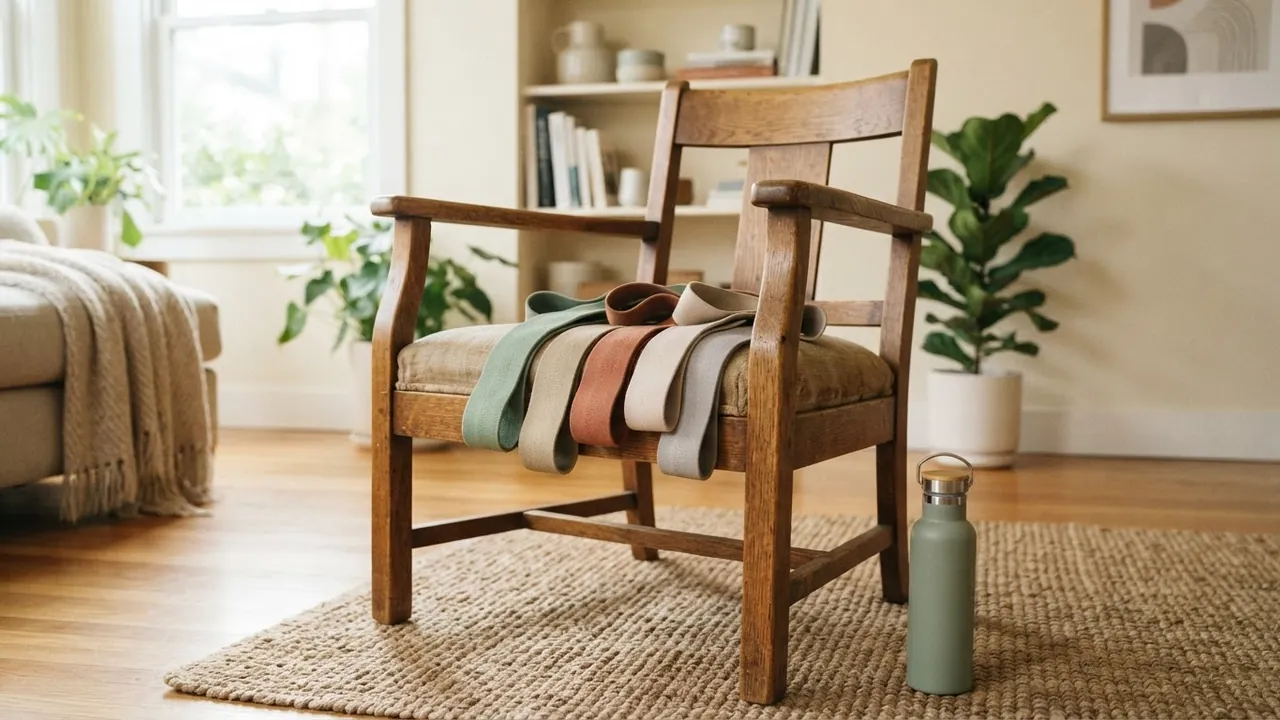
Start with tube bands that have handles, clips, and a door anchor, or with long flat therapy bands. Pick the lightest level you can pull for 8 to 12 steady repetitions. Small loop bands are useful for legs, but they are the least forgiving shape if your thighs are larger. Your body weight does not decide the band level. Your strength on each exercise does.
Bands are not a lesser version of lifting. A 2019 meta-analysis of small randomized trials compared training with elastic bands and tubes against weight machines and dumbbells, and found no difference in the strength gains for the upper or the lower body (Lopes et al., SAGE Open Medicine, 2019). The trials were small and used different programs, so treat that as “bands can do the job,” not as a promise about your arms.
Why bands suit a heavier start
Body-weight exercises move more of your own weight when you weigh more. A floor push-up, a lunge, or getting down to the floor and back up can be a big first step, and a hard first step is an easy one to skip. With a band, the load is chosen separately from your body weight. You can row, press, and pull apart from a chair, standing up, or leaning on a wall.
The US activity guidelines ask adults for muscle-strengthening work on at least 2 days a week, for the major muscle groups (Physical Activity Guidelines for Americans, 2nd edition). Bands count. So do a chair and a wall. The equipment only matters if it makes those two days more likely to happen.
The session without any equipment is on this site already: home workouts for beginners. If you already know you want a weight you can hold, the other route is adjustable dumbbells.
Which kind of band?
| Band type | What it is good for | What to watch |
|---|---|---|
| Tube bands with handles | Rows, chest presses, curls, pulldowns from a door anchor | Needs a solid door; the clips and the door anchor are the parts that wear |
| Long flat therapy bands | Seated rows around the feet, light presses, shoulder work | Light; you may outgrow the heaviest band in a set |
| Small loop bands | Glute bridges, side steps, leg work | A small circle; can roll or pinch around larger thighs |
| Large “pull-up” loops | Assisted pull-ups, heavy lower-body work | Usually too strong for a first row or press |
For most heavier beginners, tubes with handles cover the most exercises. Handles are easier on the hands than a flat band wrapped around the palm. A safety cord inside the tube, where a set has one, is there to limit how far a tube can fly if it fails.
How do you pick the first level?
Use the same test as for a dumbbell. Choose a band you can pull with a steady motion for about 8 to 12 repetitions, and stop with about two repetitions still possible. If the last reps pull your back out of position, or you hold your breath, use a lighter band or stand closer to the anchor.
The pound figures printed on bands are not dumbbell pounds. Most sets quote a resistance at a certain stretch, and the tension rises as the band gets longer. A “25 lb” tube is not a 25-pound weight at the start of a row. Compare levels within one set, not between brands.
To make a band harder, step one foot farther from the anchor, add a second tube, or slow the return. To make it easier, step closer. That small adjustment is the main reason bands work well for a beginner: the next level can be half a step away.
Is a door anchor safe?
Most problems come from the anchor or a worn band, not from the exercise.
- Put the anchor on the hinge side of the door, and close the door so it opens away from you. Lock it if someone else might open it.
- Check each tube and loop for nicks, sticky spots, or small tears before a session. Replace a damaged band.
- Keep the band away from your face on pulling moves, and do not let it snap back. Control the return.
- Do not stretch a band far beyond what the maker lists.
- If you have a latex allergy, choose a set labeled non-latex. Most tube sets are natural latex.
Sharp joint pain is a stop. Ordinary muscle ache the next day is not. If you have a heart condition, a recent injury, or a joint that already gives way, ask a clinician before you start. More in the disclaimer.
Four sets, and who each suits
As an Amazon Associate, Lean Wisely earns from qualifying purchases. The notes below come from the public product pages, not from a set we used. Resistance figures are the makers’ numbers.
The Bodylastics resistance band set (ASIN B006O09M4K) is a tube set with 2 handles, 2 ankle straps, a door anchor, and a carry bag. The listing gives six tubes with maximum resistances from 3–10 lb up to 23–90 lb, stackable to 280 lb, and describes an inner safety cord meant to limit overstretching and snapping. The lightest tube is the reason to pick it: a first row or shoulder raise can start very light and move up in small steps. The title says "Basic Series" while the selected style on the page says PRO, so check the style before checkout. It is natural latex, so it is a poor fit with a latex allergy.
The WHATAFIT resistance band set (ASIN B07V7B2VJB) also comes with handles, ankle straps, a door anchor, and a bag. The listing describes tubes from 25 to 75 lb, stackable to 300 lb, in natural latex. Its lightest tube is listed much heavier than the Bodylastics one, so it suits someone who already finds a wall push-up and a chair squat easy and wants more room to grow. It is a poor first set if rows and presses with light resistance are where you are starting. Same latex caution.
The THERABAND beginner kit, non-latex (ASIN B003YR7G8K) is three flat bands, each listed at 5 feet by 4 inches: yellow at 3–4.3 lb, red at 3.7–5.5 lb, and green at 4.6–6.7 lb. The length is what makes it work for bigger bodies: it wraps around the feet for a seated row, or behind the back for a press, without a door. It is the gentlest option here and the one to pick with a latex allergy. It is also the one you are most likely to outgrow on rows and leg work; then a tube set is the next step.
The Fit Simplify loop bands (ASIN B01AVDVHTI) are five small loops the listing gives as 12 by 2 inches, with a carry bag and an instruction booklet. They are cheap and useful for a banded glute bridge or side steps. A 12-inch loop is a small circle, though. Around larger thighs it can be tight before you move, or roll into a narrow strip. Buy them as an add-on for leg work, not as the only set.
The no-buy route is still real. A backpack with books makes a row. A wall makes a push-up. Buy a set when those are already easy and you want a load you can change by half a step.
A first week with bands
Two days, for example Monday and Thursday. Two rounds. Rest until you could say a sentence calmly.
- Seated row: flat band around the feet, or a tube from a door anchor at chest height, 8–12 reps.
- Chest press: tube anchored behind you at chest height, or a flat band around your upper back, 8–12 reps.
- Sit to a chair and stand, 8–12 reps. Hold the handles at your shoulders only when the plain version is easy.
- Glute bridge on a bed or the floor, with or without a loop above the knees, 8–12 reps.
- Band pull-apart at chest height, 10–15 reps, light.
Write down the band and the reps. Next time, try for one more rep before you move to a harder band. A missed Thursday is a missed Thursday, not a restart: habits instead of waiting for motivation.
In short
Tubes with handles and a door anchor are the most useful first set for most heavier beginners. Start with a light tube and 8–12 controlled reps. Long flat bands are the gentle and non-latex option. Small loops are an add-on for legs. Check the bands and the anchor before each session. Two days a week is the goal; the set only helps if it gets used.
Common questions
What resistance band is best for a 300 lb beginner?
Body weight does not choose the band. Strength on each exercise does. What body size changes is the shape: long flat bands and tubes with handles fit bigger bodies better than small loops. Start with a set whose lightest band is genuinely light, and use the 8-to-12-rep test.
Can resistance bands snap?
Yes. Worn or nicked bands can fail. Check them before each session, replace damaged ones, and keep the band away from your face. An inner safety cord, where a set has one, limits recoil but does not make a worn band safe.
Do bands help with weight loss?
They build strength, and a 2019 meta-analysis found similar strength gains to weights. Weight loss still depends mostly on food and total movement. Bands are for the muscle-strengthening days, not a replacement for the rest: calorie deficit in plain language.
Sources
- Lopes et al., SAGE Open Medicine, 2019: systematic review and meta-analysis of randomized trials comparing elastic resistance with weight machines and dumbbells. No difference in upper- or lower-limb strength gains. Small trials, varied protocols.
- US Department of Health and Human Services, Physical Activity Guidelines for Americans, 2nd edition: muscle-strengthening activity on 2 or more days a week for adults.
What readers think
Lean Wisely articles are general reading. See the disclaimer.