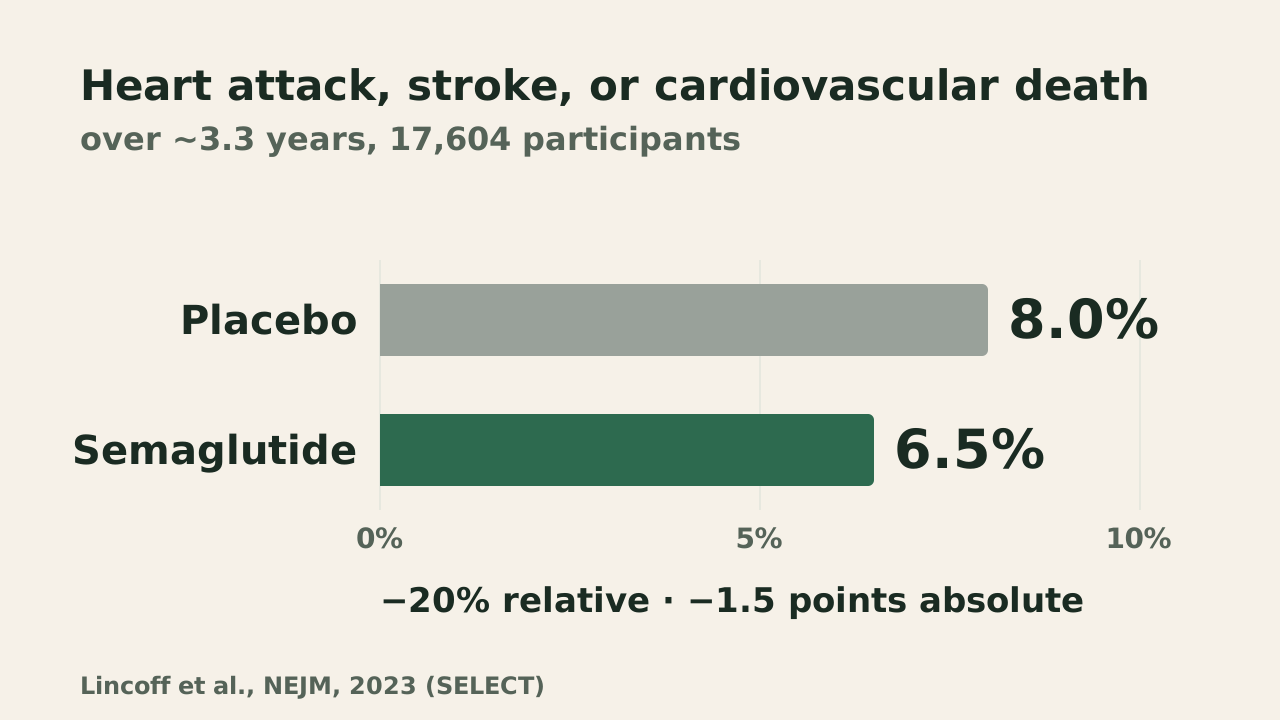
In short: SELECT was the first large randomized trial in which a weight-loss medicine reduced heart attacks, strokes, and cardiovascular deaths in people without diabetes1. The relative reduction was 20%. In absolute terms, over about 3.3 years, these events happened to 8.0% of people on placebo and 6.5% on semaglutide. But the trial only enrolled people 45 and older who already had heart or blood-vessel disease. The result does not carry over to everyone who wants to lose weight.
Who was studied
- 17,604 people in many countries, aged 45 and older1.
- All had already been diagnosed with cardiovascular disease.
- BMI of 27 or higher, and no diabetes.
- Half received semaglutide 2.4 mg once a week, half received placebo. Neither participants nor doctors knew who got which.
- Average follow-up was 39.8 months, about 3.3 years.
The trial was funded by Novo Nordisk, the maker of semaglutide1. That does not make the result unreliable, but it is worth knowing.
What it found
| Measure | Semaglutide | Placebo |
|---|---|---|
| Cardiovascular death, nonfatal heart attack, or nonfatal stroke | 569 of 8,803 (6.5%) | 701 of 8,801 (8.0%) |
| Stopped the drug because of side effects | 1,461 (16.6%) | 718 (8.2%) |
The hazard ratio for the main outcome was 0.80 (95% confidence interval 0.72 to 0.90)1. That is the “20% lower.”
How to read “20% lower”
Twenty percent is a relative reduction. The absolute difference was 1.5 percentage points over about 3.3 years: 8.0% versus 6.5%. By our arithmetic, that is roughly one event prevented for every 67 people treated for that whole period. For a medicine given to people who already have heart disease, that is a meaningful result. It is not “20% lower risk for anyone with extra weight.”
Side effects are real too: people stopped the drug because of them about twice as often as on placebo.
What SELECT does not tell you
- About people without heart disease. They were not in the trial. Whether the drug works the same way in otherwise healthy people with overweight, SELECT cannot say.
- About lifespan as such. The main outcome was cardiovascular events, not how long people lived.
- About how long to take it, or what happens after stopping. Weight tends to come back after stopping: see weight after stopping Ozempic.
- About unregulated products. The trial used approved semaglutide at the protocol dose under medical supervision. It says nothing about “alternatives” bought online.
What it means for you
If you already have heart or blood-vessel disease and carry extra weight, SELECT is a good reason to ask your cardiologist or primary care doctor whether this treatment fits you. The decision about the drug, dose, and duration belongs to your doctor. The WHO’s 2025 guideline treats GLP-1 medicines for obesity as part of wider care that includes food and physical activity2.
If you are already on semaglutide, protein and strength work matter even more during treatment: strength training on GLP-1. And without medicine, large observational studies link steps and strength work with lower risk: how many steps a day are linked to a longer life and strength training and longevity.
Common questions
Is this the same drug as Ozempic?
Same active ingredient, semaglutide. SELECT used 2.4 mg once a week, the dose used in the weight-loss trials. Products sold under different brand names differ in dose and approved use, so the result does not carry over to every pen.
Then why is it not prescribed to everyone?
Because SELECT studied a specific group: people 45 and older, with existing heart disease, and without diabetes. For them, the trial showed a benefit on its main outcome. Other groups need their own evidence, and the side effects and cost do not go away.
Sources
- Lincoff A.M. et al., SELECT Trial Investigators. Semaglutide and cardiovascular outcomes in obesity without diabetes. New England Journal of Medicine, 2023;389(24):2221–2232.
- WHO, 1 December 2025: global guideline on the use of GLP-1 medicines in treating obesity.
What readers think
Lean Wisely articles are general reading. See the disclaimer.