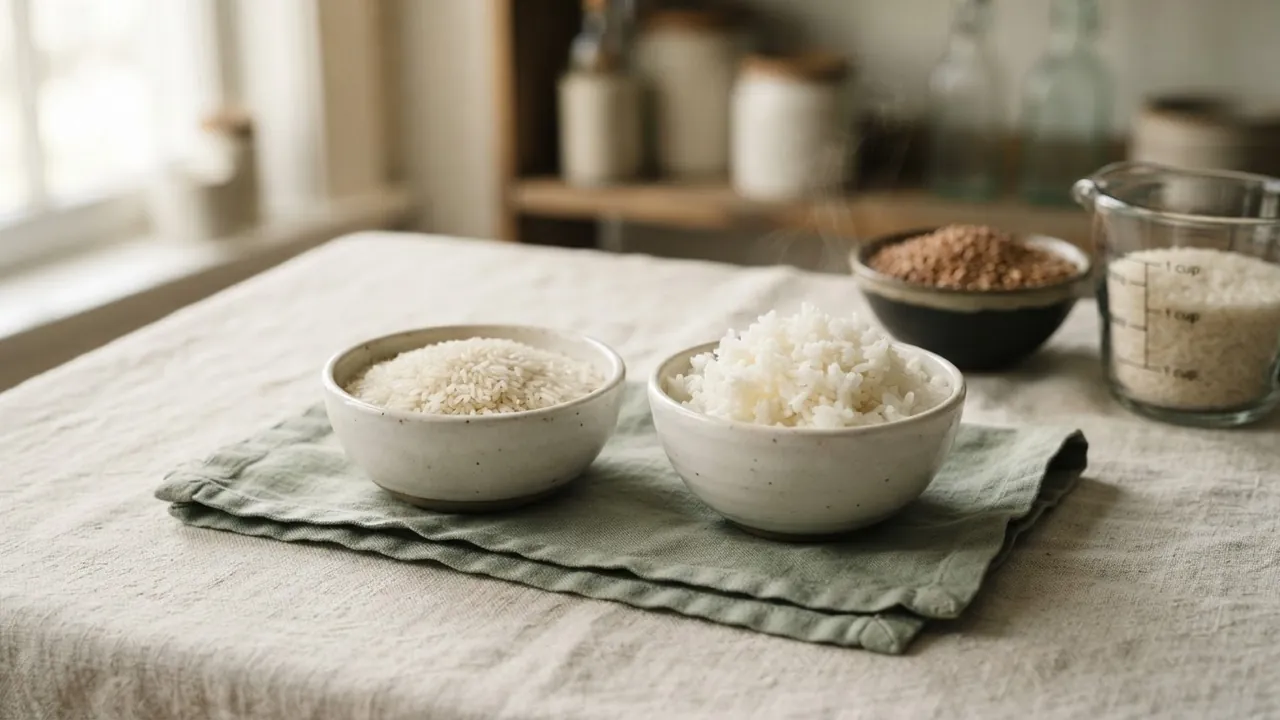
Log the weight you actually measured, and use the database entry for the same state of the grain. 100 g of uncooked long-grain white rice is 365 kcal; 100 g of cooked white rice is 130 kcal (USDA FDC 1688773, FDC 1688784). The calories did not disappear in the pot. The rice soaked up water, and the same energy is now spread over more weight. The mistake happens when you weigh the grain dry and log it as cooked, or the other way round. For rice the gap is close to threefold. For oats it is more than fivefold.
Uncooked and cooked grains: calories per 100 g
All figures are from USDA FoodData Central (SR Legacy), and each one links to its record. The cooked entries are cooked in water, with no oil or butter. Protein sits next to the calories.
| Grain | Uncooked, per 100 g | Cooked, per 100 g | Weight gain in cooking |
|---|---|---|---|
| White rice, long-grain | 365 kcal, 7.1 g 3 | 130 kcal, 2.7 g 4 | ≈2.8× |
| Brown rice, long-grain | 367 kcal, 7.5 g 5 | 123 kcal, 2.7 g 6 | ≈3.0× |
| Oats (cooked in water) | 379 kcal, 13.2 g 7 | 71 kcal, 2.5 g 8 | ≈5.3× |
| Pasta | 371 kcal, 13.0 g 15 | 158 kcal, 5.8 g 16 | ≈2.3× |
| Buckwheat groats | 346 kcal, 11.7 g 1 | 92 kcal, 3.4 g 2 | ≈3.8× |
| Bulgur | 342 kcal, 12.3 g 9 | 83 kcal, 3.1 g 10 | ≈4.1× |
| Pearl barley | 352 kcal, 9.9 g 11 | 123 kcal, 2.3 g 12 | ≈2.9× |
| Millet | 378 kcal, 11.0 g 13 | 119 kcal, 3.5 g 14 | ≈3.2× |
We worked out the last column ourselves: calories per 100 g uncooked divided by calories per 100 g cooked, from the two USDA records. That is roughly how many times heavier the grain got in USDA’s cooking conditions. Your kitchen will differ. More water, longer cooking, a lid or no lid, and the pot comes out heavier or lighter. The cooked rows are a good guide, and if you want precision, weigh your own pot once (how, below).
USDA’s cooked oats are made with water and fairly loose, which is why 100 g looks so light. Oatmeal made with milk is a different entry, and the milk is logged separately.
Calories in 1 cup of cooked rice and other grains
The cup weights below are USDA’s own measures for each cooked record. The calories are our arithmetic: grams ÷ 100 × the cooked figure from the table above. Plain grain, with no butter, oil, milk, or sugar.
| Cooked grain | 1 cup (USDA weight) | Calories per cup | Source |
|---|---|---|---|
| White rice, long-grain | 158 g | 205 kcal | 4 |
| Brown rice, long-grain | 202 g | 248 kcal | 6 |
| Oats (cooked in water) | 234 g | 166 kcal | 8 |
| Spaghetti, not packed | 124 g | 196 kcal | 16 |
| Buckwheat groats | 168 g | 155 kcal | 2 |
| Bulgur | 182 g | 151 kcal | 10 |
| Pearl barley | 157 g | 193 kcal | 12 |
| Millet | 174 g | 207 kcal | 14 |
A cup is a rough tool. Rice pressed into the cup weighs more than rice spooned in loosely, and USDA lists several cup weights for pasta depending on the shape. If you log by cups, use the same cup the same way every time. Grams are more reliable.
One cup of uncooked white rice is 185 g by USDA’s measure, or about 675 kcal3. At USDA’s cooked density that becomes roughly 520 g, a little over three cups of cooked rice. That is our calculation from the two records, not a separate measurement.
Butter is logged on its own: 10 g of unsalted butter is about 72 kcal (USDA FDC 17343017). A pat like that on a cup of buckwheat (155 kcal) adds almost half again.
How to count a whole pot
If you cook grains for several days or for the whole family, it is easier to work out your own pot once:
- Weigh the empty pot and write the number down.
- Weigh the uncooked grain. For example, 300 g of white rice is 1,095 kcal from the uncooked entry3.
- Cook as usual, then weigh the pot with the rice and subtract the empty pot.
- Divide the calories of the uncooked grain by the cooked weight. That gives kcal per gram of your rice.
- Multiply a portion in grams by that number.
A made-up example with round numbers, not a measurement: if 300 g of rice came out as 900 g cooked, 1 g is about 1.22 kcal, and a 200 g portion is about 243 kcal. By the USDA table the same 200 g would be 260 kcal4, because their rice holds more water. Neither number is “wrong”. The two pots are different.
Should you weigh grains cooked or uncooked?
- Uncooked weight repeats best: 60 g of rice is 60 g however much water you add. Check it against the package or the uncooked row.
- Cooked weight is handier if you serve from a shared pot. Then use the cooked entry, or work out your pot as above.
- In an app, read the name of the entry: “dry”, “raw”, “uncooked”, “cooked”. Two “white rice” rows almost three times apart are not a database error. They are two states of the same food.
Which method you choose matters less than sticking to one and not mixing them.
Why this mistake matters
Food logs almost always show less than people actually ate. In the OPEN study of 484 adults, where real energy use was measured with doubly labeled water, men under-reported calories on 24-hour recalls by 12–14% on average, and women by 16–20% (Subar et al., 200318). In a small NEJM study, ten people who were not losing weight while believing they ate under 1,200 kcal a day under-reported their intake by 47% on average (Lichtman et al., 199219). Mixing up uncooked and cooked weight is one of the easiest ways to get a gap like that: 60 g of uncooked rice logged as cooked rice turns 219 kcal into 783,4.
Counting in general, and how to keep it from becoming a daily exam, is in counting calories. How grains fit on an ordinary plate is in carbs and weight loss. The same raw-or-cooked question for meat is in chicken breast calories, raw vs cooked.
What to do
- Decide what you weigh: uncooked or cooked.
- Use the entry for the same state. Uncooked white rice is 365 kcal per 100 g, cooked is 1303,4.
- If you cook a pot for everyone, work out kcal per gram of your own pot once.
- Log butter, oil, milk, and sugar separately.
Common questions
How many calories are in 1 cup of cooked white rice?
By USDA, a cup of cooked long-grain white rice weighs 158 g, which works out to about 205 kcal and 4 g of protein, cooked in water with no butter (FDC 1688784). Rice packed firmly into the cup will be heavier and higher.
Is the number on the package for cooked or uncooked?
Usually uncooked. Check what the “per serving” or “per 100 g” line refers to, and compare it with the uncooked weight, not the weight of the cooked grain on your plate.
Sources
- USDA FoodData Central, SR Legacy, FDC 170685: Buckwheat groats, roasted, dry. 346 kcal, 11.73 g protein per 100 g.
- USDA FoodData Central, SR Legacy, FDC 170686: Buckwheat groats, roasted, cooked. 92 kcal, 3.38 g protein per 100 g; 1 cup = 168 g.
- USDA FoodData Central, SR Legacy, FDC 168877: Rice, white, long-grain, regular, raw, enriched. 365 kcal, 7.13 g protein per 100 g; 1 cup = 185 g.
- USDA FoodData Central, SR Legacy, FDC 168878: Rice, white, long-grain, regular, enriched, cooked. 130 kcal, 2.69 g protein per 100 g; 1 cup = 158 g.
- USDA FoodData Central, SR Legacy, FDC 169703: Rice, brown, long-grain, raw. 367 kcal, 7.54 g protein per 100 g.
- USDA FoodData Central, SR Legacy, FDC 169704: Rice, brown, long-grain, cooked. 123 kcal, 2.74 g protein per 100 g; 1 cup = 202 g.
- USDA FoodData Central, SR Legacy, FDC 173904: Cereals, oats, regular and quick, not fortified, dry. 379 kcal, 13.15 g protein per 100 g.
- USDA FoodData Central, SR Legacy, FDC 173905: Cereals, oats, regular and quick, unenriched, cooked with water, without salt. 71 kcal, 2.54 g protein per 100 g; 1 cup = 234 g.
- USDA FoodData Central, SR Legacy, FDC 170688: Bulgur, dry. 342 kcal, 12.29 g protein per 100 g.
- USDA FoodData Central, SR Legacy, FDC 170287: Bulgur, cooked. 83 kcal, 3.08 g protein per 100 g; 1 cup = 182 g.
- USDA FoodData Central, SR Legacy, FDC 170284: Barley, pearled, raw. 352 kcal, 9.91 g protein per 100 g.
- USDA FoodData Central, SR Legacy, FDC 170285: Barley, pearled, cooked. 123 kcal, 2.26 g protein per 100 g; 1 cup = 157 g.
- USDA FoodData Central, SR Legacy, FDC 169702: Millet, raw. 378 kcal, 11.02 g protein per 100 g.
- USDA FoodData Central, SR Legacy, FDC 168871: Millet, cooked. 119 kcal, 3.51 g protein per 100 g; 1 cup = 174 g.
- USDA FoodData Central, SR Legacy, FDC 169736: Pasta, dry, enriched. 371 kcal, 13.04 g protein per 100 g.
- USDA FoodData Central, SR Legacy, FDC 169737: Pasta, cooked, enriched, without added salt. 158 kcal, 5.8 g protein per 100 g; 1 cup spaghetti, not packed = 124 g.
- USDA FoodData Central, SR Legacy, FDC 173430: Butter, without salt. 717 kcal per 100 g.
- Subar A.F. et al. Using intake biomarkers to evaluate the extent of dietary misreporting in a large sample of adults: the OPEN study. American Journal of Epidemiology, 2003;158(1):1–13. PMID 12835280.
- Lichtman S.W. et al. Discrepancy between self-reported and actual caloric intake and exercise in obese subjects. New England Journal of Medicine, 1992;327(27):1893–1898. PMID 1454084.
What readers think
Lean Wisely articles are general reading. See the disclaimer.