In short: alcohol has 7 calories per gram, almost as many as fat, and the energy adds to what you eat1. Whether that shows up as weight gain is less clear. Reviews of long-term studies find that light-to-moderate drinking is not consistently tied to gaining weight, while heavy drinking more often is3. These are mostly observational findings, and none of this is a reason to start drinking.
How many calories are in a drink
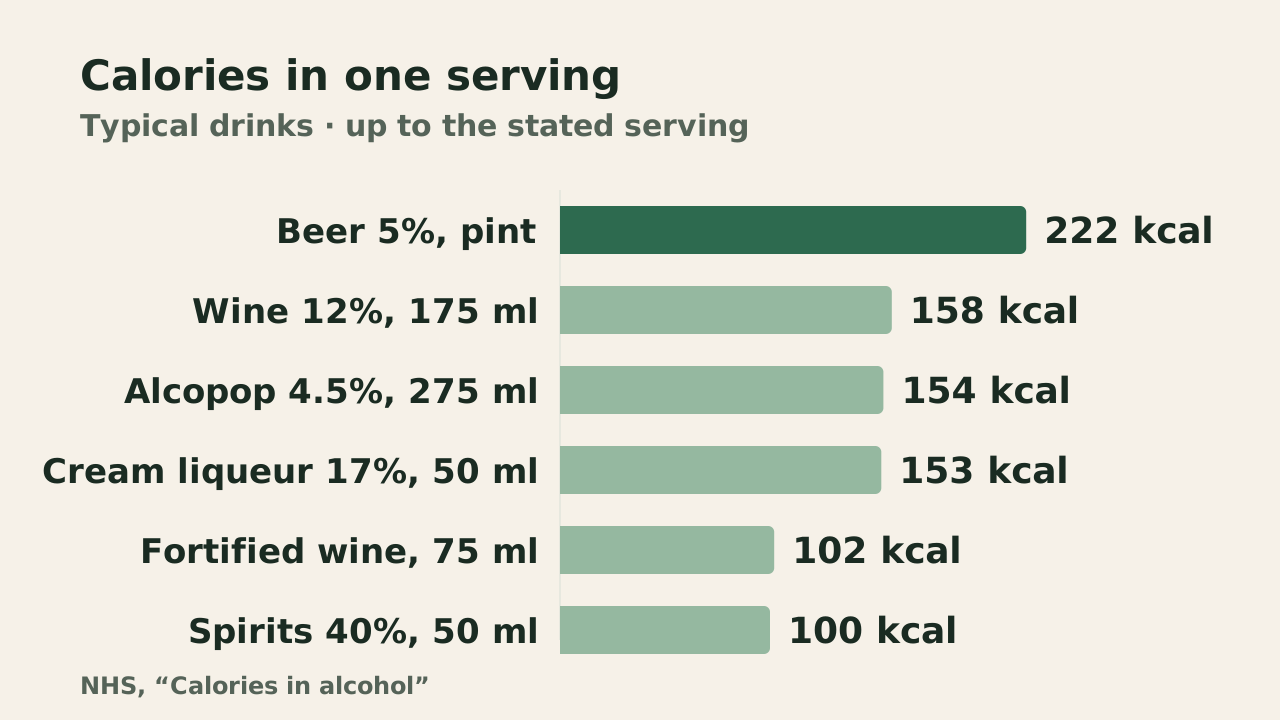
The NHS lists typical drinks. All figures are “up to” for the stated serving1.
| Drink | Serving | Energy |
|---|---|---|
| Beer, 5% | 1 pint | up to 222 kcal |
| Wine, 12% | 175 ml (5.9 fl oz), standard glass | up to 158 kcal |
| Alcopop, 4.5% | 275 ml bottle | 154 kcal |
| Cream liqueur, 17% | 50 ml (1.7 fl oz) | 153 kcal |
| Fortified wine, 17.5% | 75 ml (2.5 fl oz) | 102 kcal |
| Spirits, 40% | double, 50 ml (1.7 fl oz) | 100 kcal |
The NHS also notes that mixers such as cola or tonic add calories1. As an illustration, it says 5 pints of 5.2% lager a week add up to 57,720 kcal over a year1. That is a ceiling on energy intake, not a forecast of weight, because bodies and appetites adjust.
What the studies found
We read the abstracts of three reviews. They do not all say the same thing, which is itself the finding.
In the laboratory. A review by Martin Yeomans found that energy from alcohol is additive to energy from other food, so people end up eating more in total in the short term. Alcohol taken before or with a meal tends to increase food intake, possibly because it makes food more rewarding4.
In long-term studies. A 2015 update by Traversy and Chaput found that recent prospective studies show light-to-moderate drinking is not associated with gaining body fat, while heavy drinking is more consistently related to weight gain. Experimental evidence is mixed. Moderate intake does not seem to cause weight gain over short follow-ups3.
Across 31 publications. A systematic review by Sayon-Orea and colleagues covered cross-sectional studies, cohorts and trials. The large studies were contradictory, and the short experiments showed no clear trend. Positive links between alcohol and weight gain were mostly seen at higher levels of drinking. The review also reported that light-to-moderate wine drinking was more likely to be linked with less weight gain, and spirits with more5.
Yeomans also reported that in population data, moderate drinking was linked to a lower risk of obesity, especially in women, but that this may be due to personality and habits rather than alcohol itself4. Traversy and Chaput make a similar point: people who drink moderate amounts regularly may have healthier habits overall3.
What this does not show
- That alcohol is protective. The “lower weight in moderate drinkers” results are observational and may reflect who drinks, not what a drink does.
- That a glass can’t matter. The three reviews cannot tell you what happens to you. Traversy and Chaput conclude that alcohol may be a risk factor for obesity in some individuals3.
- Anything about health beyond weight. The NHS says regularly drinking more than recommended can show on your waistline and also cause less obvious but more serious health problems1.
- A number of kilos. None of the abstracts gives one.
The authors flag limits themselves. Traversy and Chaput point to important limitations of current studies and to many factors that could explain the conflicting findings3. Sayon-Orea and colleagues add that a person’s previous tendency to gain weight, a possible influence, had not been evaluated before5.
What to take from it
Treat alcohol like the drinks in hidden calories in drinks: energy that fills you very little. If you are working on a modest calorie deficit, it is one of the easier places to look, and the calorie calculator can help you see where your day stands. Calorie deficit in plain language explains the idea. A slip does not erase progress; see a gentle return after a slip-up.
NHS tips for avoiding weight gain include drinking water after each alcoholic drink, not drinking on an empty stomach, choosing a healthier snack if you snack, and avoiding binge drinking1. The NHS advises not regularly drinking more than 14 units a week, spread over 3 or more days. It gives 14 units as about 6 pints of average-strength beer or 10 small glasses of lower-strength wine2. If you find it hard to cut down, talk to your doctor.
FAQ
Does one glass of wine ruin a diet?
A standard 175 ml (5.9 fl oz) glass is up to 158 kcal1. That is real energy but a small part of a day. What the reviews flag more is the pattern: alcohol before or with a meal tends to raise how much people eat4.
Are spirits better than beer for weight?
Per serving, a double measure of spirits is 100 kcal against up to 222 kcal for a pint of beer1. But mixers add calories1, and one review linked spirits with more weight gain in studies5. That is an association, so it does not make a type of drink a rule.
Does alcohol-free beer or wine fix this?
We did not read a source on that, so we cannot say.
Sources
- NHS: Calories in alcohol.
- NHS: Calculating alcohol units.
- Traversy G., Chaput J.P. Alcohol consumption and obesity: an update. Current Obesity Reports, 2015;4(1):122–130.
- Yeomans M.R. Alcohol, appetite and energy balance: is alcohol intake a risk factor for obesity? Physiology & Behavior, 2010;100(1):82–89.
- Sayon-Orea C., Martinez-Gonzalez M.A., Bes-Rastrollo M. Alcohol consumption and body weight: a systematic review. Nutrition Reviews, 2011;69(8):419–431.
What readers think
Lean Wisely articles are general reading. See the disclaimer.