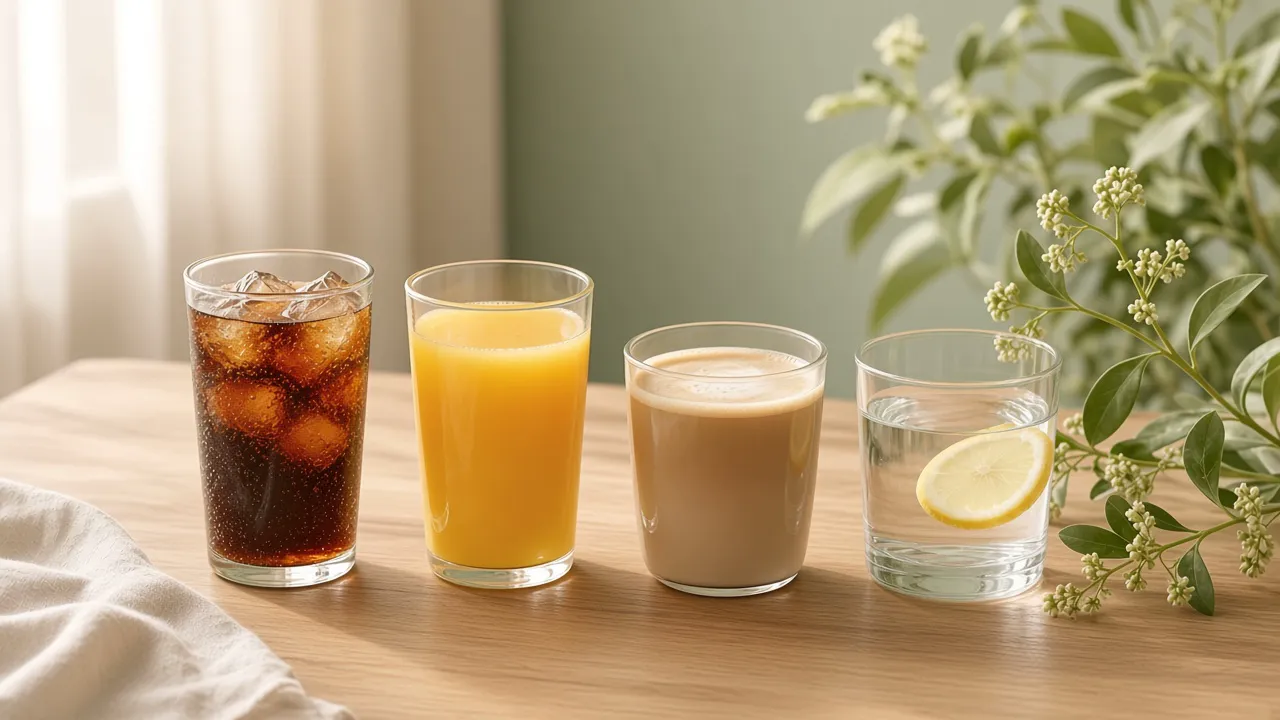
Hidden calories in drinks are energy that never lands on the plate. A large latte, a small juice carton, half a litre of sugary cola, and a glass of wine add up even when lunch was only soup.
Four ordinary portions are below. The figures are per 100 g from USDA FoodData Central. For these drinks a millilitre is close to a gram, so the table treats millilitres as grams. Syrup, cream, and the café’s own recipe move the latte. This is not a personal target and not a ban.
What a portion actually holds
| Drink | Portion | Energy | Sugars |
|---|---|---|---|
| Latte, no syrup, with 2% milk | 400 ml | 172 kcal | 16 g |
| Regular sugary cola | 500 ml | 210 kcal | 50 g |
| 100% orange juice | 200 ml, a small carton | 90 kcal | 17 g |
| Red table wine | 150 ml, one glass | 128 kcal | about 1 g |
Where the rows come from:
- Latte. USDA survey food (FNDDS), “Coffee, Latte”, FDC 2710386: a recipe with reduced-fat (2%) milk and no syrup, 43 kcal and 4.06 g sugars per 100 g. For 400 g: 43 × 4 = 172 kcal, sugars 4.06 × 4 = 16.2 g. Caramel is not in this row. A flavoured latte in the same survey, FDC 2710389, is 55 kcal per 100 g, about 220 kcal for 400 g.
- Cola. USDA SR Legacy, “Beverages, carbonated, cola, regular”, FDC 174852: 42 kcal and 9.94 g sugars per 100 g. For 500 g: 210 kcal and 49.7 g sugars.
- Juice. USDA SR Legacy, “Orange juice, raw”, FDC 169098: 45 kcal and 8.4 g sugars per 100 g. A 200 g carton: 90 kcal and 16.8 g sugars.
- Wine. USDA SR Legacy, “Alcoholic beverage, wine, table, red”, FDC 173190: 85 kcal and 0.62 g sugars per 100 g. A 150 g glass: 128 kcal and 0.9 g sugars.
These portions do not fill you much, so three of them in a day sit easily on top of meals. Black coffee and tea without sugar add very little next to these rows. How to keep a bottle of water on the desk without a “three litres or you failed” rule is separate: water as a habit.
Glasses at home rarely hold what you think. Pour your usual juice or wine into a measuring cup once, and you will know which row of the table is yours. The Pyrex 2-cup glass measuring cup (ASIN B0002ITQHS) is the ordinary kitchen version; the listing says it is marked in cups, ounces, and milliliters. As an Amazon Associate, Lean Wisely earns from qualifying purchases. After the first check, the cup can go back in the cupboard.
Fizzy drinks, juice, sweet tea
Half a litre of regular cola in the table is 210 kcal and about 50 g of sugars. That is a portion, even if the bottle disappears during one episode and there is nothing to chew. A second bottle starts easily because the first is already open. WHO advises keeping free sugars below 10% of daily energy (WHO healthy diet fact sheet). On 2,000 kcal a day that is about 50 g, roughly one such bottle.
Juice sounds gentler. “Natural” and “no added sugar” do not make it water. In the USDA row, 200 ml of 100% orange juice is about 90 kcal and 17 g of sugars. WHO counts the sugar in fruit juice, even with no added sugar, as free sugar to limit. If you like juice, pour less than a travel carton, or eat an orange.
Sweet tea belongs in the same place. Two spoons in one mug are small. Four mugs across a workday are not. Notes, when they exist, often just say “coffee.”
Coffee with milk
Black coffee barely changes the day. The 400 ml latte in the table is already 172 kcal with no syrup, on 2% milk. Whole milk or caramel goes higher: the flavoured USDA row for the same 400 g is about 220 kcal, and a particular café can be different again.
The small morning mug at home can stay. It gets noticeable when the cup is large and there are two of them. Fullness from that cup is short, so it is easy to drink and not call it food.
Alcohol, briefly
A 150 ml glass of red wine in the table is about 128 kcal. Alcohol has about 7 kcal per gram, almost as much as fat, and NHS puts a standard 175 ml glass of wine at up to 158 kcal (NHS on calories in alcohol). Almost no fullness. Nuts beside it are extra. One glass with dinner is ordinary for a lot of people. You do not need to subtract it from the week down to the last sip.
Worth noticing if the glass is not just one and the bottle stays on the table. If the evening does not hold together at all without alcohol, the question is no longer the calories in the glass. We do not diagnose.
What to change this week
A ban on everything but water usually lasts until the first gathering. It is easier to keep the sugary bottle out of sight and save the flavour for when you actually want it.
- Keep fizzy drinks for guests and a film. At home, do not park the half-litre at eye level.
- Juice as a small glass, not a travel carton every day. Or a piece of fruit you have to peel.
- Change one thing in the coffee: no syrup, or a cup smaller than 400 ml. Both on the same day is optional.
- After lunch, alternate sweet tea with tea that has no sugar.
- If you were thirsty, drink water first. Sometimes the sweet bottle is unnecessary after that.
One glass at someone else’s house does not wreck the week. Three in a day that never landed on a plate already add up: the latte, juice, and cola in the table are hundreds of kilocalories.
If the sweet stuff is not only in the bottle, there is sugar without the spiral. A label that says “light” or “sugar-free” is still worth reading: zero sugar does not make the drink a meal. How to compare “per 100 g” with “per serving” is in the label guide.
In short
If you “barely ate” and weight is stuck, remember the glass as well as the plate. A 400 ml latte, a 200 ml juice carton, 500 ml of cola, and a glass of wine are in the table above, with the portion and the source. They do not look like lunch, so they drop out of “I barely ate.”
Nearby: water through the day, and sugar if sweet is not only in the glass.
Water as a habit · Sugar without a binge
Common questions
Which drinks hide calories most often?
Sugary fizzy drinks, juice, a large latte, and alcohol. From the USDA rows above: 500 ml of regular cola is 210 kcal, a 400 ml latte with no syrup is 172 kcal, 200 ml of orange juice is 90 kcal, and a 150 ml glass of red wine is 128 kcal. They barely fill you, so they sit easily on top of meals.
Is juice better than a fizzy drink?
Juice is fruit without the chewing. It is not water. A 200 ml carton of 100% orange juice in the USDA record is about 90 kcal and 17 g of sugars. Half a litre of cola is 210 kcal and about 50 g of sugars. If you like juice, pour less.
Do you have to drop coffee with milk?
No. The small morning mug can stay. The table is about a 400 ml cup: 172 kcal with no syrup, on 2% milk. A second cup of the same size, or caramel, takes that row higher.
What readers think
Lean Wisely articles are general reading. See the disclaimer.