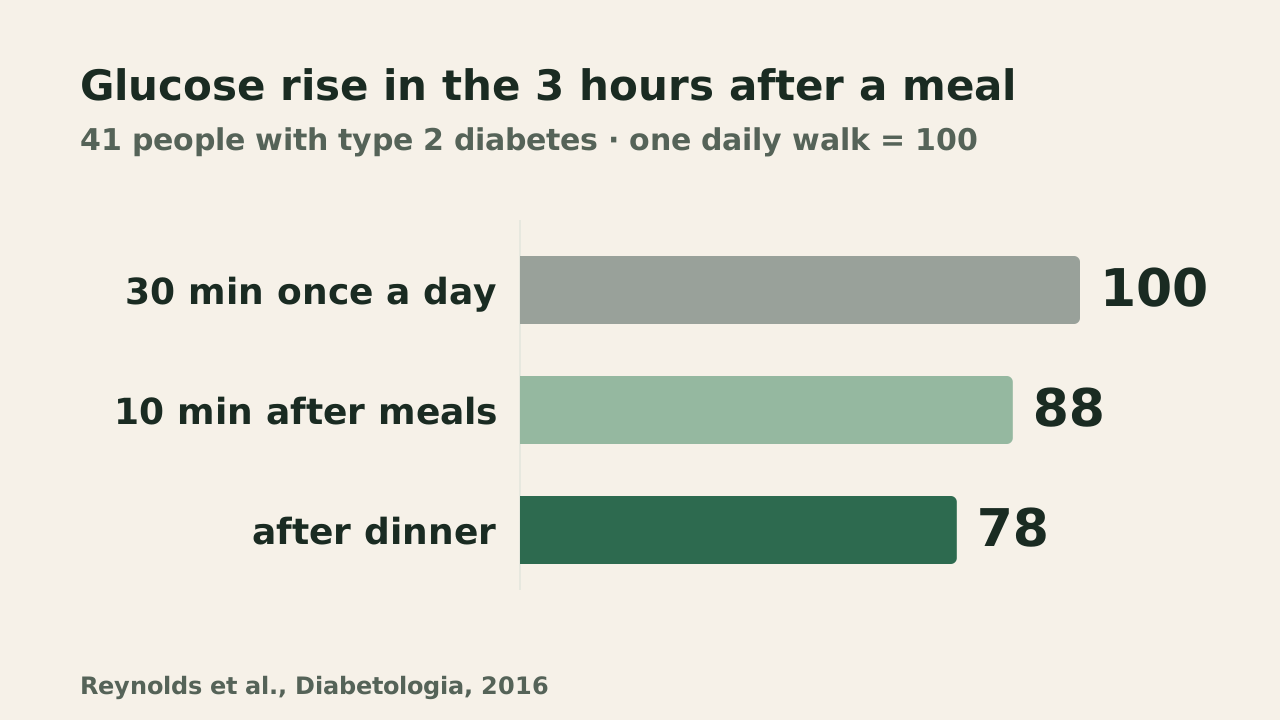
In short: in two kinds of studies, short light walks after eating lowered the rise in blood glucose compared with sitting1. In a randomized trial of 41 people with type 2 diabetes, 10 minutes of walking after each main meal lowered the 3-hour glucose rise by about 12% compared with one 30-minute walk a day2. These are short-term results. They do not show that walking after meals helps you lose weight or changes long-term disease risk.
What the meta-analysis found
A team from Limerick pooled 7 one-day randomized crossover trials in which participants, on different days, either sat without breaks or interrupted sitting with standing or light walking1. Most were adults with overweight or obesity.
- Light walking vs sitting: lower glucose after eating (standardized effect −0.72; 95% CI −1.03 to −0.41) and lower insulin (−0.83)1.
- Standing vs sitting: lower glucose (−0.31; −0.60 to −0.03), no significant effect on insulin or systolic blood pressure1.
- Walking vs standing: walking gave lower glucose (−0.30) and insulin (−0.54)1.
- Neither standing nor walking changed systolic blood pressure1.
The effects are in standardized units, not mmol/L or mg/dL, so they cannot be turned into “how much your sugar will drop”. The authors declared no conflicts of interest1.
What the type 2 diabetes trial found
Researchers in New Zealand compared two pieces of advice in a crossover design: 41 adults with type 2 diabetes (mean age 60, diabetes for about 10 years on average) followed each for 2 weeks2.
| Advice | Glucose rise in the 3 hours after a meal |
|---|---|
| Walk 30 minutes once a day | baseline (100) |
| Walk 10 minutes after each main meal | 88 (ratio 0.88; 95% CI 0.78–0.99) |
| …after the evening meal only | 78 (ratio 0.78; 95% CI 0.67–0.91) |
Glucose came from a continuous monitor and activity from an accelerometer2. Both pieces of advice met general activity guidelines. The biggest difference came after the evening meal, when the most carbohydrate was eaten and sitting was highest2. The University of Otago and the New Zealand Artificial Limb Service funded the study, and Asahi Kasei supplied reagents for one of the assays2.
What this does not show
- Weight loss. Neither study measured body weight. Weight depends on the overall balance of food and movement, covered in walking and weight loss.
- Long-term effects. The meta-analysis pooled one-day experiments1, and the trial gave each advice 2 weeks2. Neither says what happens over years.
- Real life. The meta-analysis authors note that external validity was mostly poor because of lab conditions, and that sitting for 5–8 hours straight is artificial1.
- People without diabetes. The trial was in type 2 diabetes, and its numbers should not be carried over to everyone.
- A replacement for treatment. Walking does not replace medication or your doctor’s advice.
How to use it
The takeaway is modest: a short, easy walk after eating is a reasonable way to add movement, especially after the evening meal. You can estimate your daily walking with the steps calculator. If you take glucose-lowering medicine or have diabetes, talk to your doctor about the timing and intensity of activity. This is a general explanation of studies, not medical advice.
FAQ
Do I have to walk right after eating?
In the trial, participants walked after each main meal2. It did not test a narrower window, so these studies give no answer on the best timing.
Is standing up enough?
Standing also lowered glucose a little compared with sitting, but walking did better in the meta-analysis1.
Sources
- Buffey A.J. et al. The acute effects of interrupting prolonged sitting time in adults with standing and light-intensity walking on biomarkers of cardiometabolic health: a systematic review and meta-analysis. Sports Medicine, 2022;52(8):1765–1787.
- Reynolds A.N. et al. Advice to walk after meals is more effective for lowering postprandial glycaemia in type 2 diabetes mellitus than advice that does not specify timing: a randomised crossover study. Diabetologia, 2016;59(12):2572–2578.
What readers think
Lean Wisely articles are general reading. See the disclaimer.