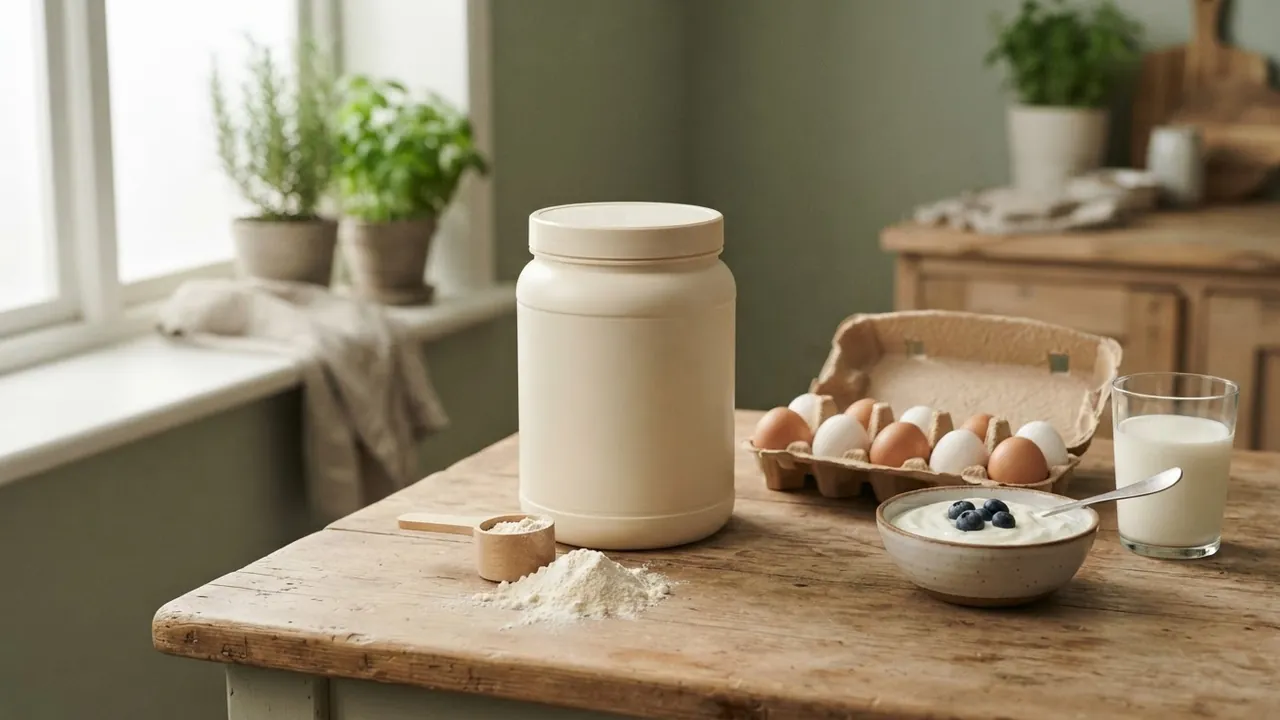
No. You do not need protein powder to lose weight. Eggs, yogurt, fish, meat, tofu, beans, and milk already provide protein, and a powder does not burn fat. A shake is useful when a meal would otherwise be short on protein and you will not cook. The calories in the scoop still count toward the day.
If ordinary food already covers your meals, skip the tub. That is the same conclusion as the plain note on protein and fullness. This page is only for the next question: if you are considering a powder anyway, what is worth reading on the label. If you take a GLP-1 medicine such as Ozempic or Mounjaro and appetite is the problem, the situation is different: protein shakes on a GLP-1.
What protein can and cannot do here
The general US protein RDA is 0.8 grams per kilogram of body weight per day. The International Society of Sports Nutrition’s position stand, written for healthy exercising people, says about 1.4 to 2.0 grams per kilogram per day is enough for most of them to build or keep muscle. In studies of people eating less on purpose, higher protein than the RDA — often alongside training — preserved more lean mass than the RDA alone. Those trials are not a personal target, and they are not a reason to add a shake on top of meals that are already large. (ISSN position stand on protein and exercise.)
A hypothetical check, arithmetic only: someone who weighs 80 kilograms has an RDA of 64 grams (80 × 0.8). The ISSN range for exercising people would be 112 to 160 grams (80 × 1.4 to 80 × 2.0). A person who does not train, or who has kidney disease, should not treat 160 grams as a goal. If a clinician has given you a protein limit, use that and ignore this paragraph.
ISSN also says a serving around 0.25 grams per kilogram, or about 20 to 40 grams of protein, is the general range used when the aim is muscle protein synthesis in athletes, and that the useful dose depends on age and recent training. A scoop listed at 20 to 24 grams sits in that range for many adults. It does not mean you should drink one after every meal. The same paper says active people can meet the day’s protein with ordinary food, and that a supplement is a practical option when it is hard to get enough protein without a lot of extra calories — a situation more common in high-volume training than in a quiet weight-loss week.
Powder is still food. An extra 150-calorie shake on top of an unchanged diet is an addition, not a cut. How the day’s energy works is in calorie deficit in plain language.
How to read a tub
- Find the serving size in grams and the protein grams in that serving. Ignore a banner that says “high protein” without the panel.
- Read sugars and the calorie line. Flavored powders differ. A chocolate scoop can be a small snack or a dessert, depending on that line.
- Read the allergen statement. Whey is from milk. Some tubs also list soy.
- If you want a check beyond the company’s word, look for a third-party mark on the tub you receive, such as NSF Certified for Sport or Informed Sport. The US Food and Drug Administration does not approve dietary supplements for safety and effectiveness before they are marketed. The company is responsible for what it sells. (FDA questions and answers on dietary supplements.)
- Compare the scoop with food you already eat. About 100 grams of roasted chicken breast is 31 grams of protein and 165 kcal in the USDA entry FDC 171477. A powder is the option when that chicken will not be there, not a better food by category.
“USDA Organic” on a plant powder means the agricultural ingredients meet an organic standard. It is not the same test as a sport certification that screens a finished tub for banned substances or checks that the protein grams match the label. A seller’s sentence about lean muscle is advertising. It is not evidence that this tub changes your weight.
Three different tubs
As an Amazon Associate, Lean Wisely earns from qualifying purchases. These notes are from the public product pages, not from a test, a purchase, or a lab we ran. None of these is a weight-loss treatment. People who need a protein limit for kidney disease, and people who are pregnant, should decide this with a clinician. General pages are not that visit: disclaimer.
The Optimum Nutrition Gold Standard 100% Whey, Double Rich Chocolate, 5 lb (ASIN B000QSNYGI) is a long-sold whey blend. The current listing says 24 grams of protein per scoop, with whey protein isolate as the primary ingredient. The tub is large, so it suits someone who already uses whey and will finish it. It is the wrong tub if you do not tolerate dairy, if a 5 lb container will sit open for months, or if you wanted a third-party sport certification — this listing does not show one. Read the calorie, sugar, and allergen lines on the tub you receive. Packaging can change, and the short bullets do not replace that panel. The maker’s muscle-building language is not a fat-loss result.
The Momentous grass-fed whey protein isolate, vanilla (ASIN B09F1SWMFG) is listed at 20 grams of protein. The page says each batch is NSF Certified for Sport and Informed Sport certified. That is a reason to consider it if you specifically want a third-party check and a smaller amount than a 5 lb bag. Look for the marks on the tub in your hand; a sentence on a product page is not the same as the seal on a later batch. It is still whey, so it is not dairy-free. The listing also mentions an enzyme blend “for bloating.” That is the seller’s claim. We did not test it. Skip this if you only needed a cheap way to add protein and ordinary food is available.
The Orgain Organic plant protein, Creamy Chocolate Fudge, 2.03 lb (ASIN B00J074W94) is the dairy-free option in this list. The listing describes 21 grams of plant protein per serving (pea, brown rice, and chia), about 150 calories, 20 servings per container, no added sugar, and a USDA Organic, vegan, soy-free powder. Choose it if you do not use dairy. Do not choose it because it is “cleaner” than food. It is not NSF Certified for Sport on the listing we checked, and 150 calories for 21 grams of protein is more energy per gram of protein than many whey isolates. Sweetened plant powders bother some stomachs. If that happens, the powder is optional and food is the fallback.
The no-buy alternative is the meal you would have cooked: eggs, yogurt, cottage cheese, canned fish, tofu, or leftover chicken. A powder is a convenience. It is not a missing nutrient for most adults who eat those foods.
Who it is not for
- Anyone hoping a scoop replaces a smaller dinner. The scoop is extra unless it replaces something else.
- Anyone with a medical protein limit.
- Anyone who wants a stimulant, a “fat burner,” or a blend of botanical extracts. Those are a different product, and this page is not recommending them.
- Anyone who already eats a protein source at meals and is only bored. Boredom is not a deficiency.
In short
Food first. If a meal will not have protein and you want a scoop, read the grams of protein, the calories, the sugar, and the allergen line. A third-party mark is a quality check, not a promise about weight. The shake counts.
Common questions
Will protein powder make me lose weight faster?
Not by itself. Higher-protein eating can make a deficit easier to live with and can help keep muscle while you eat less, especially if you also lift or do other strength work. A powder is only one way to eat protein. Adding it without changing anything else adds calories.
Whey or plant?
Whey is a milk protein with a lot of protein in a relatively small scoop. A plant blend is the relevant choice if you do not eat dairy. Compare the panel you will actually use: protein grams, calories, and sugar. The source does not decide whether the week is a deficit.
What readers think
Lean Wisely articles are general reading. See the disclaimer.