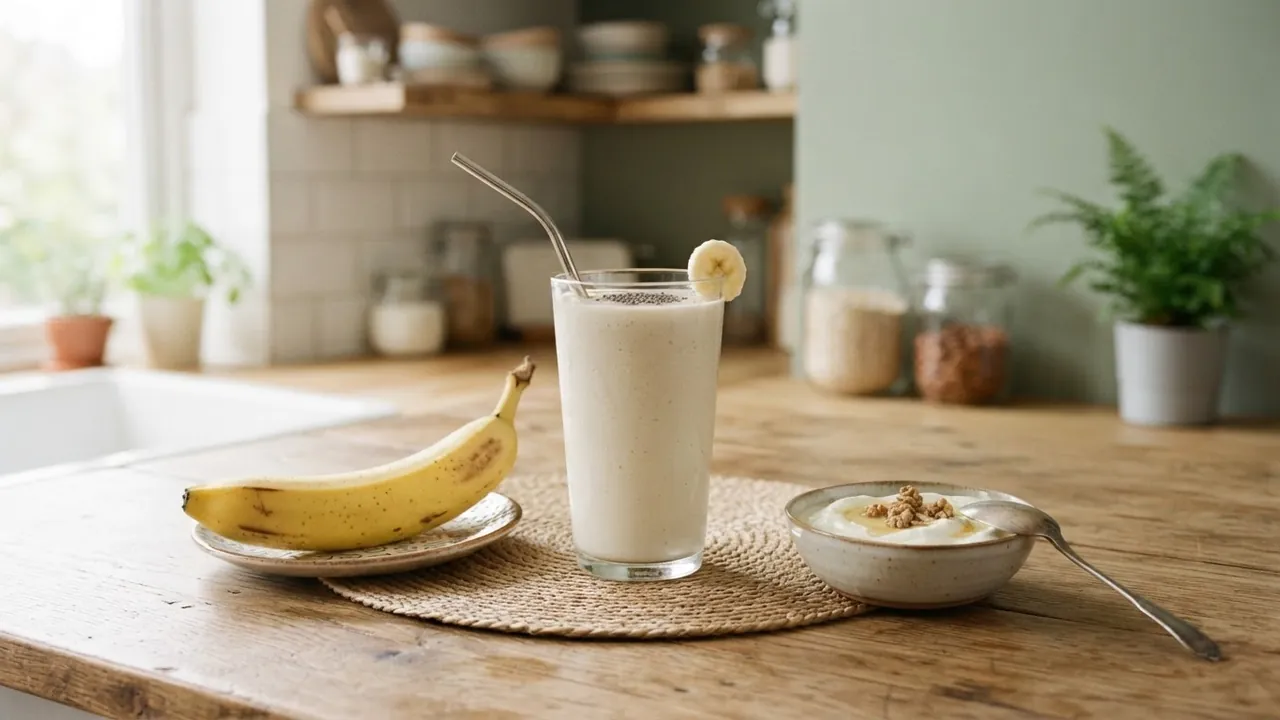
A protein shake is useful on a GLP-1 medicine when your appetite is so low that meals shrink and protein is the first thing to go. Look for about 20–30 g of protein in a serving you can actually finish, little fat, little or no sugar, and ingredients your stomach tolerates. A shake does not protect muscle on its own: the expert advisory on GLP-1 nutrition is clear that protein without strength training is likely not enough1. If ordinary food still covers your protein, you do not need one.
This is general information. Your prescriber or a registered dietitian can set a protein target for you, and that target wins over anything on this page.
Why protein gets harder on these medicines
Semaglutide (Ozempic, Wegovy) and tirzepatide (Mounjaro, Zepbound) cut appetite, and stomach side effects are common, especially in the first weeks and after each dose increase. In the obesity trials summarized by the 2025 advisory from four US nutrition and obesity societies, nausea was reported by 44% of people on semaglutide 2.4 mg (16% on placebo) and 28% on tirzepatide 15 mg (8% on placebo)1.
When you can only manage a few bites, it is easy to finish the toast and leave the eggs. Over weeks, that can mean much less protein than before, while weight is coming off fast. The advisory’s concern is muscle and bone, and its answer combines enough protein, strength training, and regular checks of strength and function1.
How much protein are people aiming for?
The advisory gives ranges, not one number1:
| What the advisory says | Grams per day |
|---|---|
| General adult allowance | 0.8 g per kg of body weight |
| Higher targets proposed during active weight loss | 1.2–1.6 g per kg |
| A simpler absolute target that may be easier to stick to | 80–120 g |
| Do not drop below | 0.4–0.5 g per kg |
| Avoid staying at or above, long term | 2 g per kg |
The authors add that it is unclear whether to count the per-kilogram targets from your actual weight, an adjusted weight, or lean mass, and that using actual weight can overestimate what someone with obesity needs. That is why the plain 80–120 g figure is useful.
A worked example, arithmetic only: 100 g a day is four servings of about 25 g, or three meals with roughly 25 g each plus one shake. On a day when breakfast is half a yogurt, a shake can carry one of those servings.
If you have kidney disease, or a clinician has given you a protein limit, follow that limit instead.
Food first, or a shake?
The advisory suggests protein foods that are filling for their size, such as fish, eggs, Greek yogurt, cottage cheese and nuts, and says some people meet their targets with protein shakes, bars and fortified foods1. Here is how ordinary portions compare with a typical ready-to-drink shake:
| Portion | Protein | Calories | Source |
|---|---|---|---|
| Greek yogurt, plain, nonfat, 1 container (170 g) | 17 g | 100 | USDA FDC 1708942 |
| Cottage cheese, 2% fat, 4 oz (113 g) | 12 g | 92 | USDA FDC 1721823 |
| Light tuna, canned in water, drained, 3 oz (85 g) | 17 g | 73 | USDA FDC 1737094 |
| Egg, hard-boiled, 1 large (50 g) | 6 g | 78 | USDA FDC 1734245 |
| Skim milk, 1 cup (245 g) | 8 g | 83 | USDA FDC 1712696 |
| Ready-to-drink shake, 11 fl oz (Premier Protein listing) | 30 g | 160 | Product listing |
A shake wins on effort and on protein per sip. Food wins on everything else the advisory cares about, including fiber, vitamins and minerals, which are harder to cover when you eat much less1. A reasonable pattern is food at meals, and a shake as the backup on days when meals do not happen.
What to read on the label
- Protein per serving. About 20–30 g is a useful serving. Check the serving size too: a 30 g bottle you only manage a third of is a 10 g serving.
- Fat. The advisory suggests avoiding fatty meals in the first days of treatment and large or high-fat meals when diarrhea is a problem1. Most shakes are low in fat, but some “meal replacement” drinks and nut-butter blends are not.
- Sugar alcohols. Look for names ending in -itol, such as sorbitol, maltitol or xylitol. In a systematic review, sugar alcohols caused dose-dependent gas, abdominal discomfort and a laxative effect in healthy people and in people with IBS7. If your stomach is already unsettled, that is one more thing to rule out.
- Fiber. Added fiber can be helpful later for constipation, which the advisory says is common. In the first days, it suggests going easy on high-fiber foods if nausea is the issue1.
- Allergens. Whey and casein are milk proteins; “lactose-free” whey is still milk. Some shakes also contain soy.
- Third-party testing, if you want it. Supplements are not approved by the FDA for safety or effectiveness before they are sold, and the company is responsible for what is in the tub8. Marks such as NSF Certified for Sport or Informed Sport are an extra check, not a promise about weight.
Ignore “for GLP-1” or “bariatric-friendly” banners when you compare. They are marketing lines. The panel is what tells you whether a shake fits.
How to drink it on a low-appetite day
- Sip it slowly rather than downing it. The advisory notes that GLP-1 medicines slow stomach emptying and that protein and fat slow it further, so a big serving can sit heavily1.
- Split a bottle or a scoop in two: half mid-morning, half in the afternoon.
- Try it thin and cold. The advisory says foods that flow easily tend to leave the stomach faster than thick ones1, so a scoop shaken with water may sit better than a thick smoothie with nut butter.
- Count the fluid. Dehydration from vomiting or diarrhea can harm the kidneys, the advisory warns1. A shake is not a replacement for water.
- If you cannot keep fluids down, or you are dizzy and barely eating for days, contact the prescriber rather than trying a different shake.
Is there a protein powder for women on a GLP-1?
Not in any way the evidence supports. The advisory’s targets are per kilogram or in plain grams per day, not split by sex1. Powders sold “for women” usually differ in serving size, flavor or added extras such as collagen or botanicals, not in the protein itself. A smaller person sits nearer the lower end of a per-kilogram range, so a 20 g serving may suit better than 30 g. Read the same panel either way.
Three shakes for three situations
As an Amazon Associate, Lean Wisely earns from qualifying purchases. These notes come from the public product pages, checked on October 4, 2026, not from a test, a purchase or a lab. None of these is a weight-loss treatment or a substitute for the prescriber’s advice.
The Premier Protein 30g High Protein Shake, chocolate, 12 pack (ASIN B008JGIZGS) is the no-prep option. The listing gives 30 g of protein, 160 calories, 1 g of sugar and 3–5 g of carbohydrate depending on flavor, describes it as low fat, and lists 24 vitamins and minerals in an 11 fl oz bottle. The allergen line on the page lists milk and soy. Choose it if you want something that lives in the fridge and needs nothing from you on a bad day. Skip it if you avoid soy, or if 11 ounces is more than you can drink: in that case split the bottle, and follow the storage note on the label once it is open. "Bariatric friendly" on the listing is the seller's phrase, not a clinical endorsement.
The Dymatize ISO100 hydrolyzed whey isolate, Gourmet Chocolate, 1.4 lb (ASIN B099HXNRKK) is a powder, which means you control the volume. The listing bullets say 25 g of protein, 1 g of fat and 1 g of sugar per serving, under 120 calories; the product details table on the same page says 140 calories and 2 g of sugar, so read the panel on the tub you receive. It mixes with water or milk, and you can make a smaller drink than any bottle, or stir half a scoop into yogurt or oatmeal. It is whey, so it is not dairy-free. Skip it if you only want a shake now and then: a 20-serving tub is a commitment once opened.
The Isopure Clear whey protein isolate, Citrus Lemonade, 1.9 lb (ASIN B081ZV62BP) mixes with water into a clear, juice-like drink. The listing gives 20 g of protein per serving, five ingredients, no artificial sweeteners and no added sugar, and calls it lactose-free and gluten-free. It does not give calories in the bullets, so check the panel. Choose it if creamy, milky shakes are what put you off. Skip it if you dislike tart drinks, or if you have a milk allergy: lactose-free whey is still a milk protein.
If you do not use dairy at all, the plant-protein pick in protein powder for weight loss is the alternative, with the same label checks.
What to do this week
- Write down what you actually ate for three ordinary days and add up the protein roughly. If you are near 80 g or your clinician’s target, food is doing the job.
- If you are well short, put a small protein food at each meal you do manage: yogurt, eggs, cottage cheese, tuna.
- Keep one shake option at home for the days when meals do not happen.
- Start or keep two strength sessions a week. The protein is there to support them.
- Tell the prescriber if nausea, vomiting or not eating lasts more than a few days.
Common questions
Can I replace meals with protein shakes on Ozempic?
Now and then, on days when a meal will not happen, a shake is better than nothing. Living on shakes leaves out the fiber, vitamins and minerals the advisory worries about when people eat much less. If you want a structured meal-replacement plan, do it with your prescriber or a dietitian.
Whey or plant protein on a GLP-1?
Neither is required. Whey isolate gives a lot of protein in a small serving and is usually low in fat and lactose. A plant blend is the choice if you avoid dairy. Pick the one you tolerate and will actually drink.
Do I still need to lift if I drink protein shakes?
Yes. The advisory says more protein alone is likely not enough to keep muscle without structured strength training1. A starter plan is in strength training on a GLP-1.
Sources
- Mozaffarian D. et al. Nutritional priorities to support GLP-1 therapy for obesity: a joint advisory from the American College of Lifestyle Medicine, the American Society for Nutrition, the Obesity Medicine Association, and The Obesity Society. American Journal of Clinical Nutrition, 2025. PMID 40450457. Also published in Obesity and in the American Journal of Lifestyle Medicine; free full text: PMC12125019. Protein targets, side-effect rates (Table 2), managing nausea, constipation, diarrhea and dehydration.
- USDA FoodData Central, SR Legacy 170894: Yogurt, Greek, plain, nonfat. 10.19 g protein and 59 kcal per 100 g; 1 container = 170 g.
- USDA FoodData Central, SR Legacy 172182: Cheese, cottage, lowfat, 2% milkfat. 10.45 g protein and 81 kcal per 100 g; 4 oz = 113 g.
- USDA FoodData Central, SR Legacy 173709: Fish, tuna, light, canned in water, drained solids. 19.44 g protein and 86 kcal per 100 g; 3 oz = 85 g.
- USDA FoodData Central, SR Legacy 173424: Egg, whole, cooked, hard-boiled. 12.58 g protein and 155 kcal per 100 g; 1 large = 50 g.
- USDA FoodData Central, SR Legacy 171269: Milk, nonfat, fluid. 3.37 g protein and 34 kcal per 100 g; 1 cup = 245 g.
- Lenhart A., Chey W.D. A systematic review of the effects of polyols on gastrointestinal health and irritable bowel syndrome. Advances in Nutrition, 2017;8(4):587–596. PMID 28710145.
- US FDA: Questions and answers on dietary supplements. Supplements are not approved for safety and effectiveness before marketing.
What readers think
Lean Wisely articles are general reading. See the disclaimer.