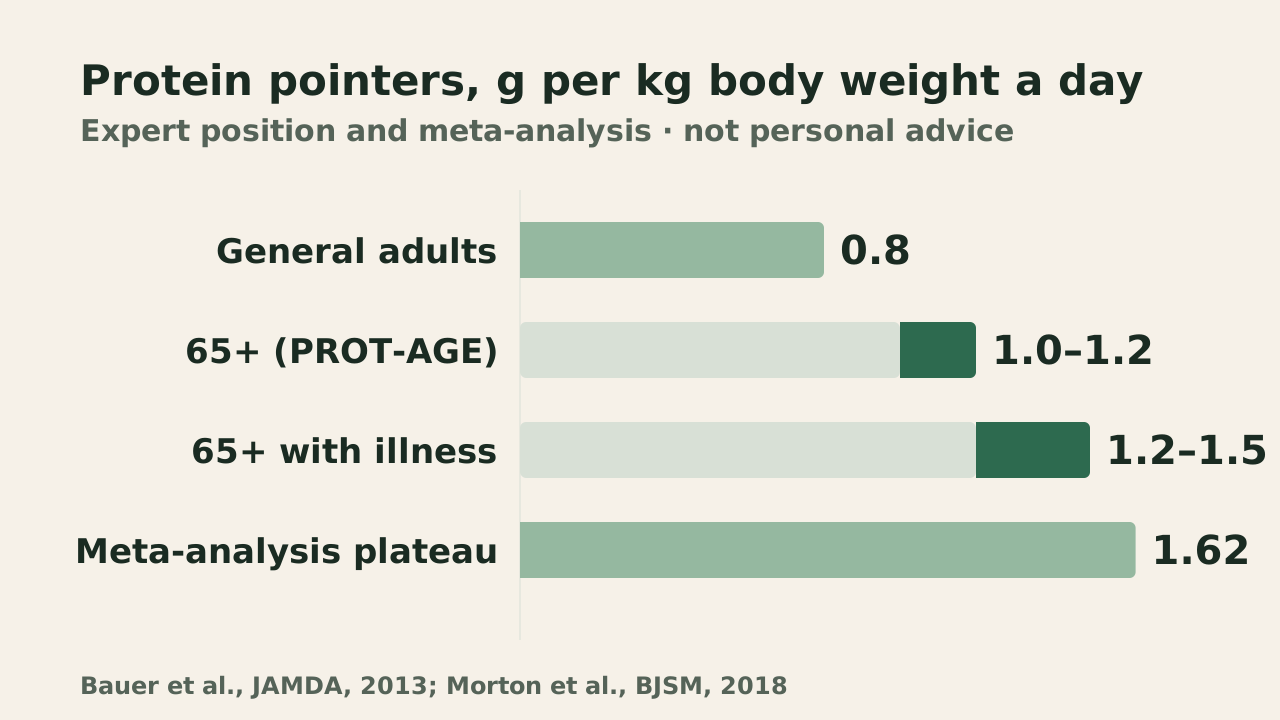
In short: the PROT-AGE expert group recommends that people over 65 eat, on average, at least 1.0–1.2 g of protein per kg of body weight a day, and 1.2 g or more if they exercise1. The general figure for adults is lower: 0.8 g per kg2. Meta-analyses of trials show that extra protein alongside strength training gives a small gain in muscle mass, and the effect is weaker without training3. This is not a prescription for any one person: with kidney disease, protein should be discussed with a doctor.
Why protein needs rise after 60
PROT-AGE notes that muscles of older people respond less to protein from food, and chronic or acute illness adds to the need1. That is why the experts suggest more than 0.8 g per kg. It is the agreed position of a group of specialists, not the result of one experiment.
The numbers
| Who | Protein, g per kg body weight a day |
|---|---|
| Healthy adults (general figure) | 0.82 |
| People over 65 (PROT-AGE) | at least 1.0–1.21 |
| Over 65 and active or exercising | 1.2 or more1 |
| Over 65 with acute or chronic illness | 1.2–1.51 |
An example for someone who weighs 70 kg (154 lb), our own arithmetic: 0.8 g per kg is 56 g a day, 1.0–1.2 is 70–84 g, and 1.2–1.5 is 84–105 g. PROT-AGE makes an exception for severe kidney disease (eGFR below 30 mL/min/1.73 m², not on dialysis): those people may need to limit protein1.
What the trials show
A meta-analysis of 74 randomized trials in healthy, non-obese adults found that extra protein during resistance training modestly increased lean body mass (standardized difference 0.22; 95% CI 0.14–0.30; moderate certainty)3. In people 65 and older the effect was significant at 1.2–1.59 g per kg a day. Lower-body strength rose slightly more, but the effect on handgrip is unclear and on physical function tests it is minimal3.
Another meta-analysis of 49 studies and 1,863 participants found that protein supplements added to strength training gave on average 0.30 kg more fat-free mass and 2.49 kg more on a one-repetition maximum. The effect on mass shrank with age, and above roughly 1.6 g per kg there was no further gain4.
An extra 0.3 kg over a period of training is a modest figure. Protein is a helper here, not a replacement for strength sessions: see strength training and longevity.
What this does not prove
- It is not about disease or lifespan. The studies measured muscle mass and strength, not falls or years of life.
- Mostly healthy people. The meta-analyses covered healthy adults, and PROT-AGE is an expert position, not a direct trial of the requirement.
- Funding and ties. Both meta-analyses have an author who reports honoraria from dairy and beef industry bodies, and one includes employees of food companies34.
- No exact number. PROT-AGE states that evidence on protein quality and timing is not yet enough for specific recommendations1.
What to take from it
Work out your own figure: multiply your weight by 1.0–1.2 and compare it with what you actually eat. If it is far lower, add protein to every meal rather than to just one. What counts as a portion is covered in protein and fullness in plain words. You can estimate your weight and calorie needs with the calorie calculator. If you have kidney disease or another chronic condition, talk to your doctor first.
FAQ
Is a lot of protein bad for the kidneys?
These sources do not reach that conclusion for healthy people. But for severe kidney disease PROT-AGE makes an exception: protein may be limited1. If you have kidney disease, your doctor decides.
Do I need protein powder?
The meta-analyses compared supplements with regular eating, but that does not mean you cannot do without powder. The goal is total protein across the day, which regular food can supply.
Is protein alone enough without training?
These data point the other way: the gains in mass were measured alongside strength training3.
Sources
- Bauer J. et al. Evidence-based recommendations for optimal dietary protein intake in older people: a position paper from the PROT-AGE Study Group. J Am Med Dir Assoc, 2013;14(8):542–559.
- Mozaffarian D. et al. Nutritional priorities to support GLP-1 therapy for obesity: a joint advisory. Obesity Pillars, 2025;15:100181 (cited for the 0.8 g per kg recommended daily figure).
- Nunes E.A. et al. Systematic review and meta-analysis of protein intake to support muscle mass and function in healthy adults. J Cachexia Sarcopenia Muscle, 2022;13(2):795–810.
- Morton R.W. et al. A systematic review, meta-analysis and meta-regression of the effect of protein supplementation on resistance training-induced gains in muscle mass and strength in healthy adults. Br J Sports Med, 2018;52(6):376–384.
What readers think
Lean Wisely articles are general reading. See the disclaimer.