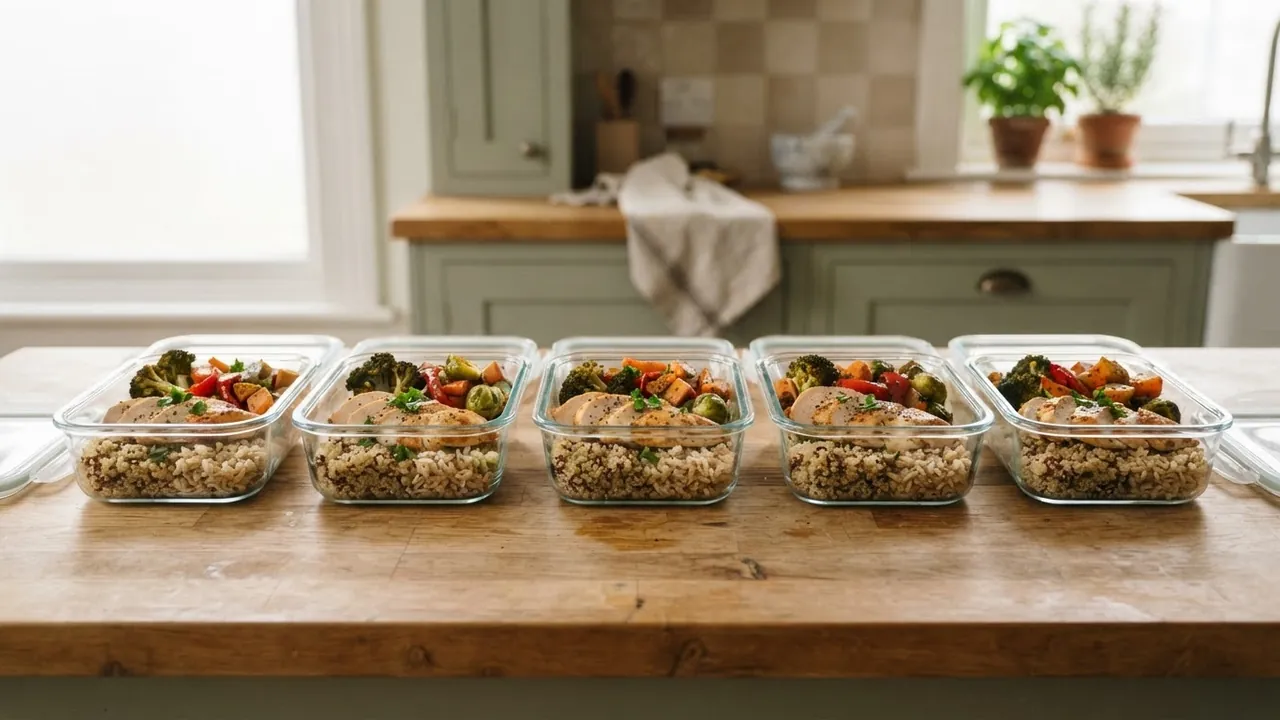
Cook four of the same lunch, not a perfect week of different dinners. Each box gets a protein you already know how to cook, vegetables, and a starch you weighed once. Cool it in shallow containers, refrigerate within 2 hours, and eat refrigerated portions within 3 to 4 days. Freeze what you will not eat in that window. The box does not cause weight loss. It only decides the portion before you are hungry at a desk.
That is the whole method. The rest is food safety, what to put in the box, and when a set of containers is worth buying.
One session that survives a weekday
Pick the meal you usually replace with whatever is nearby. For many people that is lunch. Breakfast can stay as eggs or yogurt you already make in the morning.
A workable hour:
- Choose one protein, one vegetable, and one starch. Chicken and rice, beans and potatoes, tofu and pasta. You do not need a new recipe.
- Cook the protein to a safe temperature. Poultry needs 165°F in the thickest part, measured with a food thermometer, not judged by color. (USDA leftovers and food safety.)
- Weigh the starch for one lunch, then repeat that weight three more times. Dry rice and cooked rice are different foods on a scale; the method is in how to use a kitchen scale.
- Put the four lunches in separate containers while the food is still easy to portion. A single family pot in the fridge becomes “I’ll just take a little more.”
- Refrigerate within 2 hours of cooking (1 hour if the room is above 90°F). Shallow containers cool faster than a deep pot. Hot food may go straight into the fridge.
- Eat refrigerated leftovers within 3 to 4 days, or freeze them. USDA’s window for frozen leftovers, for quality more than safety, is about 3 to 4 months. Reheat leftovers to 165°F.
Four lunches is enough. A seventh container of food you are bored of on Thursday usually becomes waste, and waste pushes you back to takeout.
What goes in the box
Use the same plate you would eat if you were not prepping: protein, vegetables, and a starch you can see. Protein and fullness is the reason the protein is there. It is not a rule that the box must hit a gram target.
An illustration, using USDA per-100-gram figures, not a prescription for your lunch:
- 100 grams of roasted chicken breast, meat only: 165 kcal and 31 grams of protein (FDC 171477).
- 150 grams of cooked enriched long-grain white rice: 150/100 of 130 kcal, about 195 kcal (FDC 168878).
- 14 grams of olive oil, if you use it on the vegetables: about 124 kcal (FDC 171413, 884 kcal per 100 grams).
That sample is about 484 kcal before vegetables, sauce, or a drink. Change the grams if you are larger, smaller, or training that day. The point of writing it out is that the oil is a real part of the lunch, and 100 grams of cooked chicken is not a vague “some chicken.” Vegetables can fill the rest of the box without a scale. A snack between this lunch and dinner, if you need one, is covered in snacks that keep you full.
Sauce and dressing belong in a small separate cup if they make the vegetables soggy by Wednesday. That is a texture problem, not a metabolism problem.
Containers, if the ones you own are not enough
As an Amazon Associate, Lean Wisely earns from qualifying purchases. These notes are the makers’ listed specs and the public product pages, not a test in our kitchen. Any lidded box you already own can hold a portion. Glass does not stain the way tomato sauce stains some plastic, and it is heavy in a bag you carry on foot.
The Rubbermaid Brilliance 3.2-cup glass containers, set of 4 (ASIN B08B7GLYZC) is four boxes of the same size, which matches “four of the same lunch.” The listing describes glass bases, plastic lids, a leak-proof claim, dishwasher use (lids on the top rack), freezer use, and microwave reheating with the lids handled the way the product says — vented or unlatched, not sealed shut. The glass bases are listed as oven-safe up to 450°F. The lids are not ovenware. Choose this set when you want four matching lunches and you can see what is inside. Skip it if you walk a long way with lunch: glass plus food is a heavy bag. A 3.2-cup box is a moderate lunch; it will not hold a large soup plus bread.
The Pyrex Simply Store (9-Pack) Mixed Sized Glass Food Storage Set (ASIN B0157G34AY) is nine pieces of round and rectangular glass, with plastic lids the listing calls BPA-free. The listing describes the set as microwave and dishwasher safe. Use a smaller piece for a sauce or a snack portion and a larger one for a batch you will divide later. It is less tidy than four identical boxes. The lids are plastic, so do not treat them as ovenware. Skip it if you only needed four of the same lunch and do not want mixed sizes in the cabinet.
The Rubbermaid Brilliance glass set of 9 (ASIN B08BR9HBZ3) adds smaller and larger pieces: three 1.3-cup, two 2-cup, two 3.2-cup, one 4.7-cup, and one 8-cup, with lids. The 1.3-cup size is a sauce or a fruit portion; the 8-cup is a batch, not one person’s lunch. The listing puts the set around 14.9 pounds before food, so it needs a shelf. Same glass-and-lid rules as the 4-pack: follow the lid instructions in the microwave, and do not treat the lid as oven-safe. This is the “one purchase covers lunches and small sides” option. It is the wrong buy for a small kitchen.
Reusing takeout boxes you already wash is the no-buy option. They are often less leak-proof, and a stained lid is only a problem if you stop using them. Portion the food; the logo on the lid does not matter. Do not microwave a container that is not marked microwave-safe. The USDA reheating note is to use a microwave-safe glass or ceramic dish and vent the cover so steam can leave.
What usually goes wrong
- Prepping seven dinners on Sunday and eating none of them by Wednesday.
- Leaving the pot on the stove to “cool” for the afternoon. Two hours at room temperature is the USDA line, one hour in real heat.
- Building the box from only rice because the chicken took longer. You will be hungry, and the prep did not fail because you lack discipline.
- Assuming a glass lid and a plastic lid follow the same oven rule. Read the piece you are about to heat.
In short
Four of the same lunch, a starch you weighed, protein and vegetables in the same box, fridge within 2 hours, eaten within 3 to 4 days or frozen. A container helps if it makes that portion easy to grab. It does not replace the rest of the day.
Common questions
Does meal prep cause weight loss?
No. It can make a usual lunch more repeatable, which helps if random lunches were larger than you thought. The week’s food still has to sit under your usual intake. How to think about that gap is the calorie deficit piece.
Can I prep five days of chicken?
USDA’s refrigerator window for leftovers is 3 to 4 days. Cook a batch you will eat in that time, and freeze the rest. Thaw in the fridge, not on the counter.
What readers think
Lean Wisely articles are general reading. See the disclaimer.