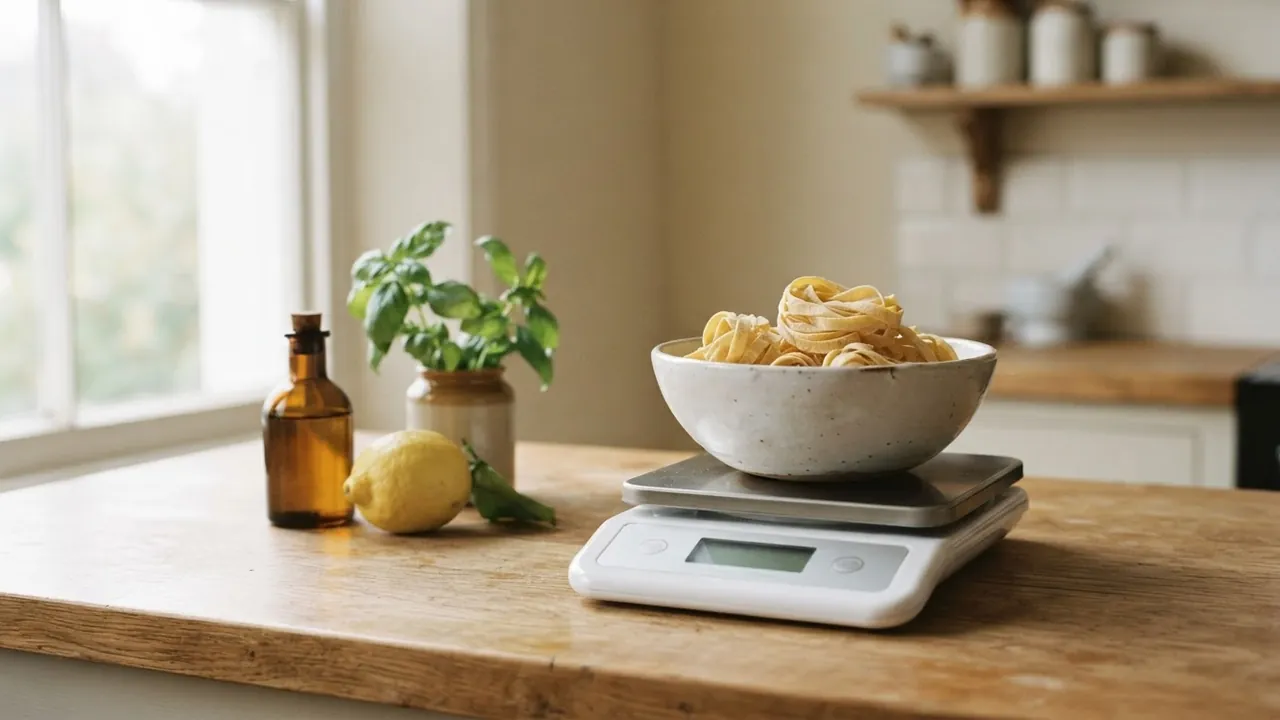
Weigh the foods that are easy to pour too much of: oil, nut butter, cheese, cereal, and dry grains. Put the empty bowl on the scale, press tare so the display reads zero, then add the food and read the grams. A scale does not create a calorie deficit. It makes a few portions less of a guess while you are learning them. The one rule that matters most: log a raw weight against a raw entry and a cooked weight against a cooked entry.
You do not need to weigh lettuce, cucumber, or black coffee. Once a usual portion is familiar, you can go back to the eye for that food and keep the scale for the dense ones. Counting without turning the log into a daily trial is a separate question: counting calories without the obsession.
Do food scales help with weight loss?
Indirectly. A scale is a tool for keeping a food record, and keeping track is what the research looks at. A systematic review of 22 behavioral weight-loss studies found a consistent link between self-monitoring (food records, exercise logs, self-weighing) and weight loss, while rating the evidence as weak because most studies were small, similar groups relying on self-report (Burke et al., 20111).
A record is also rarely complete. In a small controlled study, women trained to keep a seven-day weighed food record still under-recorded by about 429 kcal a day on average against energy expenditure measured with doubly labeled water; dietitians under-recorded by about 223 kcal (Champagne et al., 20022). A scale narrows the gap on the foods you weigh. It does not make a log exact.
The sequence
- Set the scale on a flat counter. Soft mats and tilted boards make cheap sensors drift.
- Choose grams. Ounces work if the label is in ounces. Skip fluid ounces for solid food: that mode is a volume estimate for water or milk, not a weight.
- Put the plate, bowl, or spoon on the scale first.
- Press tare (sometimes labeled zero). The container disappears from the number.
- Add the food. If you are building a bowl, tare again before the next ingredient so each one has its own grams.
- Write the grams next to a matching entry: the label’s grams, or a database line for the same food in the same state.
The FDA’s point on a Nutrition Facts label is easy to miss: the serving size is the amount people typically eat, not a recommendation of how much you should eat. The nutrition numbers belong to that stated amount, usually shown as a household measure plus grams. If you eat twice the grams, you ate two servings of those numbers (FDA: serving size on the Nutrition Facts label3).
Raw or cooked: which weight to log
Water leaves meat as it cooks, while dry rice, pasta, and oats take water up. So 100 g of a food changes its calories when it changes state, and USDA lists raw and cooked versions as separate entries. Use a raw entry for a raw weight and a cooked entry for a cooked weight.
Per 100 g, USDA FoodData Central, SR Legacy. Each figure links to its entry.
| Food | Dry or raw, per 100 g | Cooked, per 100 g |
|---|---|---|
| White rice, long-grain, enriched | 365 kcal 4 | 130 kcal 5 |
| Pasta, enriched | 371 kcal 6 | 158 kcal, boiled without salt 7 |
| Oats, regular or quick | 379 kcal 8 | 71 kcal, cooked with water 9 |
| Chicken breast, skinless | 120 kcal, 22.5 g protein 10 | 165 kcal, 31.0 g protein, roasted 11 |
Weigh rice cooked or uncooked? Uncooked is easier to repeat, because the amount of water a pot of rice takes up depends on the pan, the lid, and how long it sat. Here is what a mix-up costs: 75 g of dry rice is about 274 kcal on the dry entry4. Logged by mistake against the cooked entry, the same 75 g reads about 98 kcal5. If you cook a pot for several people, weigh the dry rice, weigh the whole cooked pot, and work out the calories per gram of your own pot.
Weigh meat raw or cooked? Raw, if you can, for the same reason: cooking loss varies. USDA’s yield table puts roasted chicken breast at an average of 72% of its raw weight, with a range of 61% to 82% (USDA Table of Cooking Yields, 2012, p. 3712). The roasted chicken line is not “more calories added by cooking.” A cooked piece is denser because water left, so 100 g cooked is a smaller piece of meat than 100 g raw. Portions of 150 g and 200 g, raw and cooked, are worked out in chicken breast calories per 100 g: raw vs cooked.
Dense foods where a few grams matter
| Food | Per 100 g | Entry |
|---|---|---|
| Olive oil | 884 kcal | FDC 171413 13 |
| Peanut butter, smooth, no salt | 598 kcal, 22.2 g protein | FDC 172470 14 |
| Cheddar, sharp, sliced | 410 kcal, 24.2 g protein | FDC 170899 15 |
A short arithmetic check, not a personal target: 14 grams of olive oil is 14/100 of 884 kcal, about 124 kcal13. Thirty-two grams of that peanut butter, which USDA lists as 2 tablespoons, is about 191 kcal and about 7 grams of protein14. Twenty-eight grams of that cheddar, which USDA lists as a 1 oz slice, is about 115 kcal15. If your jar prints a different gram weight for “2 tbsp,” use the jar.
What to weigh, and what to leave
Weigh oil, nut butter, cheese, nuts, granola, dry rice or pasta before cooking, and breakfast cereal. Those are the foods where a heavy pour changes the day.
Leave leafy salad, herbs, plain tea, and diet soda. Weighing them teaches very little and makes the scale feel like a chore. A palm of meat or a ladle of cooked grain is a fair guess after you have weighed that food a few times. The carb piece uses about 150 grams of cooked grain as a visible ladle: carbs and weight loss.
If the number makes dinner with other people tense, stop the detailed log. The CDC’s weight page treats a few days of a food diary as a way to see the pattern, not as a permanent assignment (CDC: steps for losing weight16).
A scale, if you want one
As an Amazon Associate, Lean Wisely earns from qualifying purchases. The notes below are the makers’ listed specs and the public product pages, not a test in our kitchen. Any digital kitchen scale with grams and a tare button does this job. A phone app is not a substitute for the weight.
The Etekcity food kitchen scale (ASIN B0113UZJE2) is a flat stainless model listed at 11 lb / 5 kg, with 1 gram steps, a tare button, and units that include grams and ounces. It also offers a milliliter mode for water and milk. Use grams for food. It fits someone who wants a basic scale and will keep it on the counter. It is a poor fit if a deep bowl covers the display, because the screen sits in the platform. The 5 kg limit is enough for a bowl of food and not for a large stockpot.
The OXO Good Grips 11-pound scale (ASIN B079D9B82W) is the stainless model whose page lists an 11 lb capacity, a zero function for taring, unit conversion, and a pull-out display so a large plate does not shade the numbers. The platform is described as removable for cleaning. Choose it when you weigh in a mixing bowl. Skip it if you only need a scale that lives in a drawer and you do not want a larger body on the counter. Same 11 lb ceiling as the Etekcity.
The Greater Goods digital kitchen scale (ASIN B01JTDG084) is the gray plastic model. The page lists an 11 lb / 5 kg capacity, a tare/zero function for weighing in a bowl, and units that include grams. One product-detail line says a 1 g readout, and a bullet on the same page says accuracy “down to 2 grams.” Those two lines do not match, so treat the smallest step as something to check on the unit you receive. It is the plain option when you do not need a pull-out screen. It does not solve a hidden display under a wide pot.
Measuring spoons are the no-buy route for oil if you already own them, and they are less repeatable than grams: a “tablespoon” of peanut butter depends on how you pack it. Borrow a scale for two weeks if you do not want to own one. The number you need is the gram weight, not the brand.
Common mistakes
- Weighing after you have already poured, then logging a round number from memory.
- Logging raw chicken grams against a roasted entry, or dry rice grams against a cooked entry.
- Trusting the fluid-ounce mode for olive oil. That mode assumes the density of water, and oil is lighter, so the reading is off. Weigh it in grams.
- Zeroing before the bowl is on the scale, so the bowl’s weight is counted as food.
- Treating every gram of spinach as equally worth weighing. It is not.
In short
Tare the container, read grams, and match the food’s state to the entry you log. Use that for oil, nut butter, cheese, cereal, and dry grains. Leave the salad. When the portions are obvious, the scale can go back in the drawer.
Common questions
Do I have to weigh food forever?
No. A few weeks is enough for the foods you misjudge. After that, weigh again when a new package shows up or the scale weight on the plate starts drifting.
Is a kitchen scale better than measuring cups?
For oil, nut butter, cheese, and cereal, grams are more repeatable than a packed cup. Cups are fine for water. The label’s gram line is the one that matches the calories printed next to it.
Sources
- Burke L.E., Wang J., Sevick M.A. Self-monitoring in weight loss: a systematic review of the literature. Journal of the American Dietetic Association, 2011;111(1):92–102. PMID 21185970.
- Champagne C.M. et al. Energy intake and energy expenditure: a controlled study comparing dietitians and non-dietitians. Journal of the American Dietetic Association, 2002;102(10):1428–1432. PMID 12396160.
- U.S. Food and Drug Administration. Serving size on the Nutrition Facts label.
- USDA FoodData Central, SR Legacy, FDC 168877: Rice, white, long-grain, regular, raw, enriched. 365 kcal per 100 g.
- USDA FoodData Central, SR Legacy, FDC 168878: Rice, white, long-grain, regular, enriched, cooked. 130 kcal per 100 g.
- USDA FoodData Central, SR Legacy, FDC 169736: Pasta, dry, enriched. 371 kcal per 100 g.
- USDA FoodData Central, SR Legacy, FDC 169737: Pasta, cooked, enriched, without added salt. 158 kcal per 100 g.
- USDA FoodData Central, SR Legacy, FDC 173904: Cereals, oats, regular and quick, not fortified, dry. 379 kcal per 100 g.
- USDA FoodData Central, SR Legacy, FDC 173905: Cereals, oats, regular and quick, unenriched, cooked with water, without salt. 71 kcal per 100 g.
- USDA FoodData Central, SR Legacy, FDC 171077: Chicken, broiler or fryers, breast, skinless, boneless, meat only, raw. 120 kcal, 22.5 g protein per 100 g.
- USDA FoodData Central, SR Legacy, FDC 171477: Chicken, broilers or fryers, breast, meat only, cooked, roasted. 165 kcal, 31.02 g protein per 100 g.
- Showell B.A. et al. USDA Table of Cooking Yields for Meat and Poultry. USDA ARS Nutrient Data Laboratory, December 2012, p. 37: chicken breast, baked or roasted, mean yield 72% (61–82%).
- USDA FoodData Central, SR Legacy, FDC 171413: Oil, olive, salad or cooking. 884 kcal per 100 g.
- USDA FoodData Central, SR Legacy, FDC 172470: Peanut butter, smooth style, without salt. 598 kcal, 22.21 g protein per 100 g; 2 tbsp = 32 g.
- USDA FoodData Central, SR Legacy, FDC 170899: Cheese, cheddar, sharp, sliced. 410 kcal, 24.25 g protein per 100 g; 1 oz slice = 28 g.
- Centers for Disease Control and Prevention. Steps for losing weight.
What readers think
Lean Wisely articles are general reading. See the disclaimer.