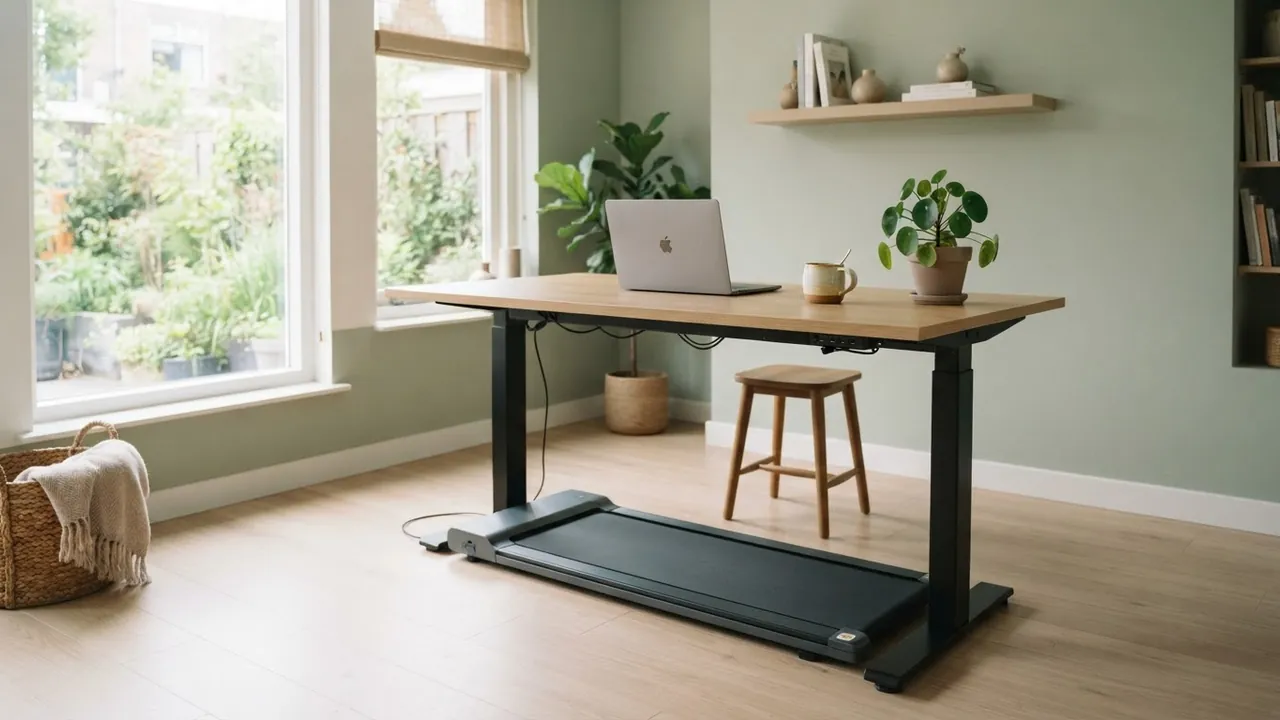
A walking pad is worth buying only if you will use it on days you would otherwise sit still, and only if it fits under your desk, matches a weight limit you can live with, and feels steady at a slow speed. It does not replace a calorie deficit, and it does not replace a real walk outside. If you already walk most days, you do not need one.
The ordinary version of this idea — shoes, a route, and a few more steps — is walking and weight. A pad is the indoor variant for weather, a dark street, or a job that keeps you in a chair.
What it can change, and what it cannot
CDC’s adult guideline is at least 150 minutes a week of moderate-intensity activity, plus muscle-strengthening on 2 days. The same page says some activity is better than none, and that adults benefit from sitting less. Brisk walking is the example of moderate activity. (Adult activity.)
“Brisk” has a speed attached. CDC lists walking at 2.5 miles per hour or faster as a moderate-intensity example. On their effort scale, moderate work is about a 5 or 6 out of 10, where sitting is 0. You can talk, but not sing. Activity under 3 METs is not in that moderate band. (How to measure intensity.)
Most under-desk walking is slower than 2.5 mph, because typing falls apart when the belt speeds up. That slower walk is still movement instead of sitting. It is not automatically the 150-minute moderate target. A pad that also has a faster mode can be used for a separate brisk walk when you are not trying to use a keyboard. The display’s calorie number is the machine’s estimate from speed and time. It is not a measurement of what you used, and it is not a number of pounds you will lose.
Weight change still depends on the week of food. A pad does not cancel a larger dinner. CDC’s pace for weight loss, when weight loss is the goal, is about 1 to 2 pounds a week, from the whole pattern of eating, activity, sleep, and stress — not from one piece of equipment. (Steps for losing weight.)
A decision you can actually use
Buy one only if most of these are true:
- You sit for long stretches and an outdoor walk is often blocked.
- You have measured the space under the desk, including the deck and any handle. If your keyboard tray or chair arms collide with the machine, the pad will live in a closet.
- You can stand on it while holding a stable desk, at the slowest speed, without feeling unsteady.
- Your body weight is under the listed maximum, with room to spare. The maximum is the maker’s limit for the machine, not a medical clearance.
- You will walk on it during calls or shows you already have, at least a few days a week. A folded pad does not add steps.
Skip it if you want to run, feel dizzy or unsteady, or are shopping because the purchase feels like a plan. An incline only helps if the model you buy lists one. Joint pain, chest symptoms, or a heart condition are reasons to agree the activity with a clinician first. These pages are general: disclaimer.
Strength work is a separate two-day habit, with or without a pad. A short version that needs no machine is home workouts for beginners.
Walking pad with handrails, for seniors or shaky balance
Most flat pads have nothing to hold. Of the three below, the UREVO lists a safety handle and the folding WalkingPad lists adjustable handrails; the C2 has neither. If balance is the main worry, or you are buying for an older parent, look for long rails on both sides and a slow starting speed. That usually means a compact treadmill rather than a pad. Those, and machines rated above 265 lb, are compared in walking pads for 300 lb and up.
Three machines with different jobs
As an Amazon Associate, Lean Wisely earns from qualifying purchases. Specs below are what the product pages list, not a workout we filmed. “Quiet,” “joint protection,” and “weight loss” lines in the ads are the sellers’ claims. A walking pad is a belt with a motor. Follow the manual for lubrication and for the user weight limit. Start at the slowest speed. Stop if you feel chest pain, dizziness, or pain in a joint.
| UREVO Strol 2E Pro | WalkingPad C2 | WALKINGPAD folding treadmill | |
|---|---|---|---|
| Listed speed | 0.4–6.2 mph overall; walking mode 0.6–4 mph | 1–4 mph | 0.5–7.5 mph |
| Listed user limit | 265 lb | 220 lb | 240 lb |
| Shape | 12% incline, safety handle, app | Folds in half, about 5.4 inches tall folded; remote or app | Folds; adjustable handrails; listing calls the brushless motor quiet |
The UREVO Strol 2E Pro Smart Walking Pad (ASIN B0H1H4JT4C) lists an overall speed of 0.4–6.2 mph, a walking mode of 0.6–4 mph, a 12% incline, a safety handle, and a 265 lb maximum. An app is listed. Choose it if you want that higher listed weight limit, plus an incline and a handle. Under a desk, stay in walking mode; 6.2 mph is not a typing pace. The handle and the incline take more room than a flat belt, so measure the space you actually have. It is a poor fit if the handle will not clear the desk, or if you wanted a pad with nothing to hold.
The WalkingPad C2 (ASIN B0H6WSKDZN) folds 180 degrees; the listing gives a folded height of about 5.4 inches, a weight of 55 lb with two wheels, and no assembly. Speed is listed at 1–4 mph, set with a remote or an app, so it is a walking machine, not a running one. The listed user limit is 220 lb, the lowest of the three here. Choose the C2 if storage is the problem: it can slide under a bed or a sofa. Skip it if you are near or above 220 lb, or if you want a handrail. The earlier C2 listing we linked went out of stock; this is the maker’s current listing.
The WALKINGPAD Folding Treadmill, 2 in 1 Walking Pad with Handle Bar (ASIN B0H6LNG9FM) lists 0.5–7.5 mph, a 240 lb maximum, a fold, and adjustable handrails. The listing calls the brushless motor quiet. Choose it if you want something to hold and a speed range that includes a faster walk when you are not trying to type. The 240 lb limit is lower than the UREVO’s 265 lb. Skip it if you are over that listing, or if a raised handrail will not fit the room you actually have. Store it only if you will take it back out. Folded and unused, it does not add steps.
The no-buy alternative is a walk outside, a hallway loop, or a treadmill at a gym you already use. A phone in your pocket can count the steps. None of that requires a motor.
In short
A walking pad earns a place if it turns sitting time into slow walking you will repeat. It does not earn a place as a weight-loss machine. Keep the speed honest: under a desk you are mostly sitting less, and a brisk walk is a separate block if you want the moderate-intensity minutes CDC describes.
Common questions
Will a walking pad help me lose weight?
Only as part of moving more while the week’s food stays in a deficit. The slow speeds used at a desk are below CDC’s brisk-walking example, so do not treat an hour of email at 1.5 mph as a hard workout. It can still be worthwhile as less sitting.
Is an under-desk treadmill the same as a gym treadmill?
No. A gym treadmill is built for running and usually has a longer belt. Of the three here, the UREVO Strol 2E Pro lists a 12% incline. The WalkingPad C2 and the folding WalkingPad do not list one. The C2’s top speed is a brisk walk. The folding WalkingPad lists up to 7.5 mph, which is a jog for many people, not a running workout. If you want to run, this is the wrong category.
What readers think
Lean Wisely articles are general reading. See the disclaimer.