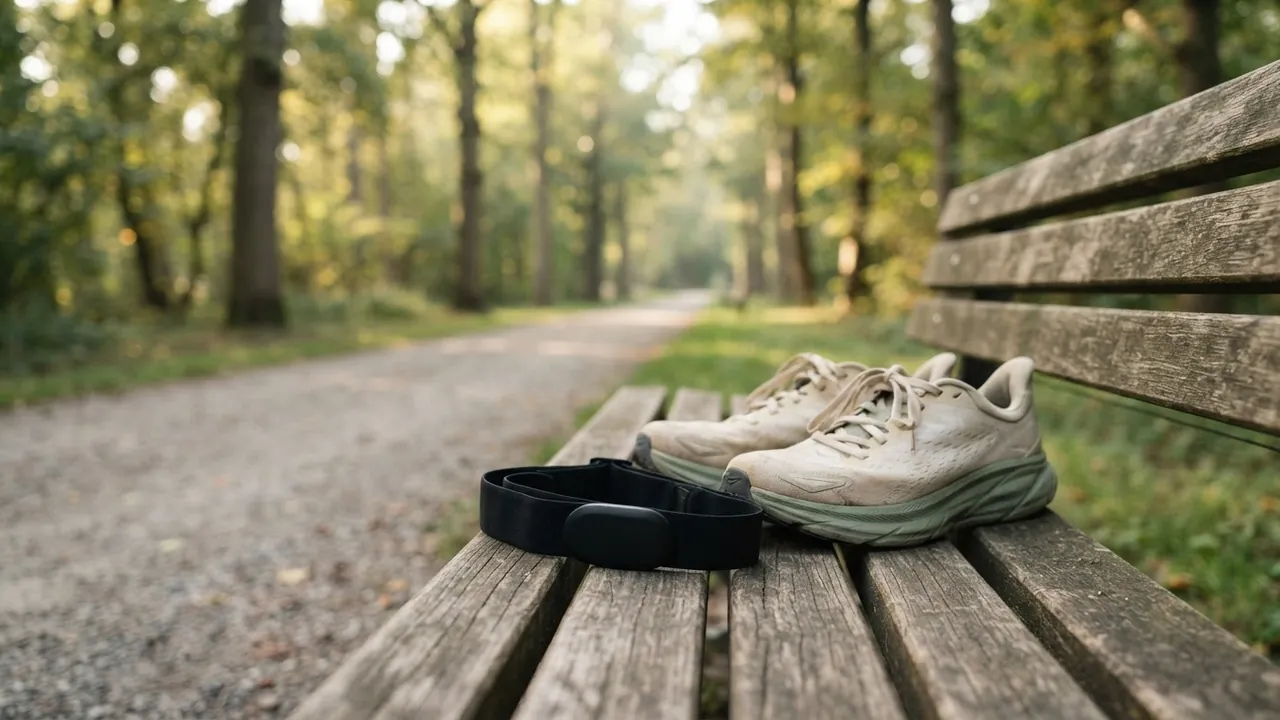
Most beginners do not need a chest strap for zone 2. The talk test does the job: if you can say a full sentence but could not comfortably sing, you are in the moderate range people call zone 2. A strap earns its place in three cases: you ride an indoor bike or use equipment where a wrist sensor struggles, you keep drifting harder than you meant to, or you want a reliable record of your sessions. It is the wrong tool if you take a beta-blocker, because the medicine holds the heart rate down and the zone on the screen stops matching the effort.
Whether zone 2 is the best cardio for fat loss is a separate question, and the trials do not name a winner: zone 2 or HIIT for fat loss. This page is only about measuring it.
Is the talk test good enough?
For a first few months, usually yes. A 2022 systematic review of the talk test in people with heart and lung conditions found that the last stage where people could still speak comfortably lined up with the first ventilatory threshold, the point where breathing starts to climb faster (Vieira et al., Reviews in Cardiovascular Medicine, 2022). The authors also note that protocols vary, so it is a practical guide, not a lab measurement.
It costs nothing and works on any machine, outside, and with any medicine. The weak spot is honesty on hard days: people talk themselves into “I could still speak” while breathing hard. That is where a number helps.
Chest strap or wrist?
A chest strap reads the heart’s electrical signal through electrodes on the skin. A watch estimates heart rate optically from blood flow under the sensor. In a study of 50 adults on a treadmill, a bike, and an elliptical trainer, the chest strap agreed most closely with an ECG across all conditions. The wrist devices did well on the treadmill, varied more on the bike, and none was accurate on the elliptical when the arms were moving the levers (Gillinov et al., Medicine & Science in Sports & Exercise, 2017). Those were 2017 devices. Newer watches may do better, but the pattern of “wrist is fine for steady walking, less so for gripping and pedaling” is a fair starting assumption.
| Method | Extra cost | Best for | Weak spot |
|---|---|---|---|
| Talk test | Free | Walking, easy cycling, anyone on a beta-blocker | Easy to fool yourself on a hard day |
| Watch you already own | None | Steady walking and running | Gripping, pedaling, arm-lever machines |
| Chest strap | One more device | Indoor cycling, gym equipment, a reliable log | Another strap to wet, wear, and wash |
If you already own a watch, try the talk test and the watch together for two weeks. If they agree, you are done. If the watch jumps around on the bike, that is the case for a strap.
What to check before you buy
- Connections. Bluetooth for phones and most watches. ANT+ for many bike computers and some gym machines. Check what your own equipment uses.
- How many devices at once. Some straps can talk to two Bluetooth devices at the same time, for example a phone app and a bike computer.
- Battery. Coin-cell straps need a new battery now and then. Use the size the maker lists.
- Strap size. Measure your chest where the strap sits. A strap that has to be stretched to its limit slips and reads badly.
- The app you will actually open. A strap sends a number. The app is where you see it.
- Washing. A strap that holds sweat starts to smell and can read worse. Detachable sensors make the strap easy to rinse.
Can you use a chest strap with Apple Watch?
Yes, as long as the strap has Bluetooth. Apple’s steps are short: put the strap in pairing mode, then on the watch open Settings, tap Bluetooth, and choose it (Apple Support: Bluetooth accessories3). Apple itself suggests a Bluetooth chest strap when the wrist sensor cannot get a steady reading, and names the usual reasons: cold weather that reduces blood flow in the skin, some tattoos, and irregular movement such as tennis or boxing (Apple Support: accurate measurements4).
Three things trip people up:
- The strap is already talking to your phone. Polar says the H10 can be paired with several devices but usually works with one at a time, unless you switch on its two-Bluetooth-devices setting in the Polar Beat or Polar Flow app (Polar Support5). If the watch does not see the strap, close the fitness app on your phone, or turn the phone’s Bluetooth off for a minute while you pair.
- ANT+ does not help here. Apple’s guide is about Bluetooth accessories. A strap that lists both is fine; the Bluetooth side is the one the watch uses.
- Dry electrodes. Strap makers tell you to wet the electrode zones before you start; the COOSPO listing below says so too. A dry strap is a common reason for a missing or jumpy reading, whatever it is paired with.
Which of the three straps below makes sense with an Apple Watch? If the watch is the only screen you want, the Polar H9 or the COOSPO is enough: both list Bluetooth. The COOSPO listing names apps such as Strava and Zwift rather than the Apple Watch, so treat it as a plain Bluetooth strap; we have not paired one ourselves. If you want the watch and a phone app or a bike screen at the same time, the Polar H10 is the one that lists two Bluetooth connections at once.
To check the setup, start a short walking workout and watch the number for a few minutes. It should settle at an easy pace and rise when you speed up, rather than jump around. Then note what it reads at the pace where you can speak in full sentences but not sing: that number is your working zone 2, better than a chart.
Three straps, from budget to research-grade
As an Amazon Associate, Lean Wisely earns from qualifying purchases. The notes below are from the public product pages, not a test we ran. Accuracy claims are the makers’ claims.
The COOSPO H808S chest strap (ASIN B07R8741CN) is the budget option. The listing gives Bluetooth 4.0 and ANT+, compatibility with apps such as Strava, Zwift, Peloton, and Polar Beat, and an LED light and beep that show whether it is connected. It also reminds you to wet the electrode zones before use and to pair the strap inside the app rather than in the phone's Bluetooth settings. Choose it if you want to find out whether heart-rate numbers change what you do, without paying for a brand name. Skip it if you want onboard memory; the listing does not mention any.
The Polar H9 (ASIN B08411DQ96) is Polar's entry strap. The listing says it works with heart-rate-compatible equipment and phone apps, uses a CR2025 coin cell (included), and comes in two sizes: XS-S for 20–26 inches and M-XXL for 26–36 inches. Polar's own page adds Bluetooth, ANT+, and a machine-washable strap once the sensor is removed. It suits most people who want a known brand and nothing extra. Check the size range against your chest before you order; if you are above the top of it, look for a longer strap first.
The Polar H10 (ASIN B07PM54P4N) is Polar's top strap, and research groups often use it as the reference device. A 2026 study of the Google Pixel Watch 3, for example, measured the watch against an H10 (Lambe et al., PLOS ONE, 2026). The listing gives Bluetooth, ANT+, and 5 kHz, two Bluetooth connections at the same time, internal memory, a waterproof sensor, and a strap with silicone dots meant to keep it from slipping. Choose it if you ride with both a phone and a bike computer, or you want the sensor to record without a phone nearby. For a walk at a talking pace it is more than you need.
None of these straps makes a session count more. The minutes you repeat every week are what matter, and a walk at a talking pace is already zone 2 for many people: walking and weight.
In short
Use the talk test first. Add a chest strap if you train on a bike or machine where your watch reads poorly, if you keep going harder than you intended, or if you want a clean log. The COOSPO is the cheap trial, the Polar H9 the plain choice, and the Polar H10 the one for two devices and onboard memory. On a beta-blocker, skip the zones and keep the talk test.
Common questions
Is a wrist heart rate monitor accurate enough for zone 2?
Often, for steady walking or running. It is less reliable on a bike, with a tight grip, or on arm-lever machines. Check it against the talk test for a couple of weeks before you buy anything.
Can I use a chest strap with just my phone?
Yes. All three straps above list phone app support over Bluetooth. You pair the strap inside the app you plan to use.
What heart rate is zone 2 for me?
Age-based formulas give a rough range and can be far off for an individual. The talk test is a better first guide than a formula. A lab test is the precise route. If you take medicine that affects heart rate, ask your clinician rather than using a chart.
Sources
- Gillinov et al., Medicine & Science in Sports & Exercise, 2017: 50 adults; a Polar H7 chest strap had the closest agreement with ECG across treadmill, bike, and elliptical. Wrist optical monitors varied by exercise type and were least accurate on the elliptical with arm levers.
- Vieira et al., Reviews in Cardiovascular Medicine, 2022: systematic review of the talk test in cardiopulmonary patients. Last comfortable-speech stage corresponded to the first ventilatory threshold. Protocols vary.
- Apple Support, "Use AirPods and other Bluetooth accessories with Apple Watch": pairing heart rate monitors through Settings, Bluetooth on the watch.
- Apple Support, "Get the most accurate measurements using your Apple Watch": skin perfusion, tattoos and irregular motion affect the wrist sensor; Bluetooth chest straps as an alternative.
- Polar Support, "Can I pair H10 with several devices?": usually one connection at a time; a two-Bluetooth-devices option in Polar Beat and Polar Flow.
What readers think
Lean Wisely articles are general reading. See the disclaimer.